The Best UK Casino Sign-Up Bonus Once You Read the Small Print
Current as of 7 November 2026 and checked against the Gambling Commission’s public register of remote casino operating licences.

A “sign-up bonus” is a sales page written around a number. The page says one thing, the terms say another, and the gap between them is where the player pays. In the UK the gap shrank in late 2026: from 19 December 2025 the Gambling Commission capped wagering requirements at 10x, mixed-product bonuses were banned, and the marketing language had to catch up with the rule book. That is the environment this page reads against. What follows looks at what a sign-up bonus actually is in this market, who has to hold which licence to offer one, what the offer really costs the person claiming it, and which of the ten GB-licensed operators on the Commission’s own register have a sign-up offer worth examining at all.
- What sits behind a UK sign-up bonus
- Why the Gambling Commission licence changes the calculation
- The 10x cap, and what it actually costs to clear a bonus
- The no-deposit version, and why it is rarer than the marketing suggests
- What the credit-card ban and Faster Payments mean at the cashier
- Safer-gambling protections that arrive with the bonus
- The ten GB-licensed operators on the public register
- What each licence actually obliges the operator to do
- Reading a sign-up bonus offer against the terms
- The arithmetic behind a representative £100 bonus
- Grosvenor Casinos
- Betfred
- 32Red
- BetVictor
- William Hill
- Virgin Games
- Ladbrokes
- Paddy Power
- Betfair
- Jackpotjoy
- What the comparison actually comes down to
- What an offer cannot legally look like in the UK
- Frequently asked questions about UK casino sign-up bonuses
What sits behind a UK sign-up bonus
A casino sign-up bonus is credit the operator adds to a new account, typically tied to a first deposit and unlocked only after a fixed amount of play. The basic shapes are three. A deposit match multiplies the first deposit by a stated percentage, usually 100%, and pays it as bonus funds. A no-deposit bonus credits a small amount — often free spins or a few pounds — without requiring a deposit first. Free spins, sometimes bundled with the other two, run on a named slot at a fixed coin value. Most offers combine more than one shape: a 100% match up to a stated ceiling, with a fixed bundle of free spins on top.
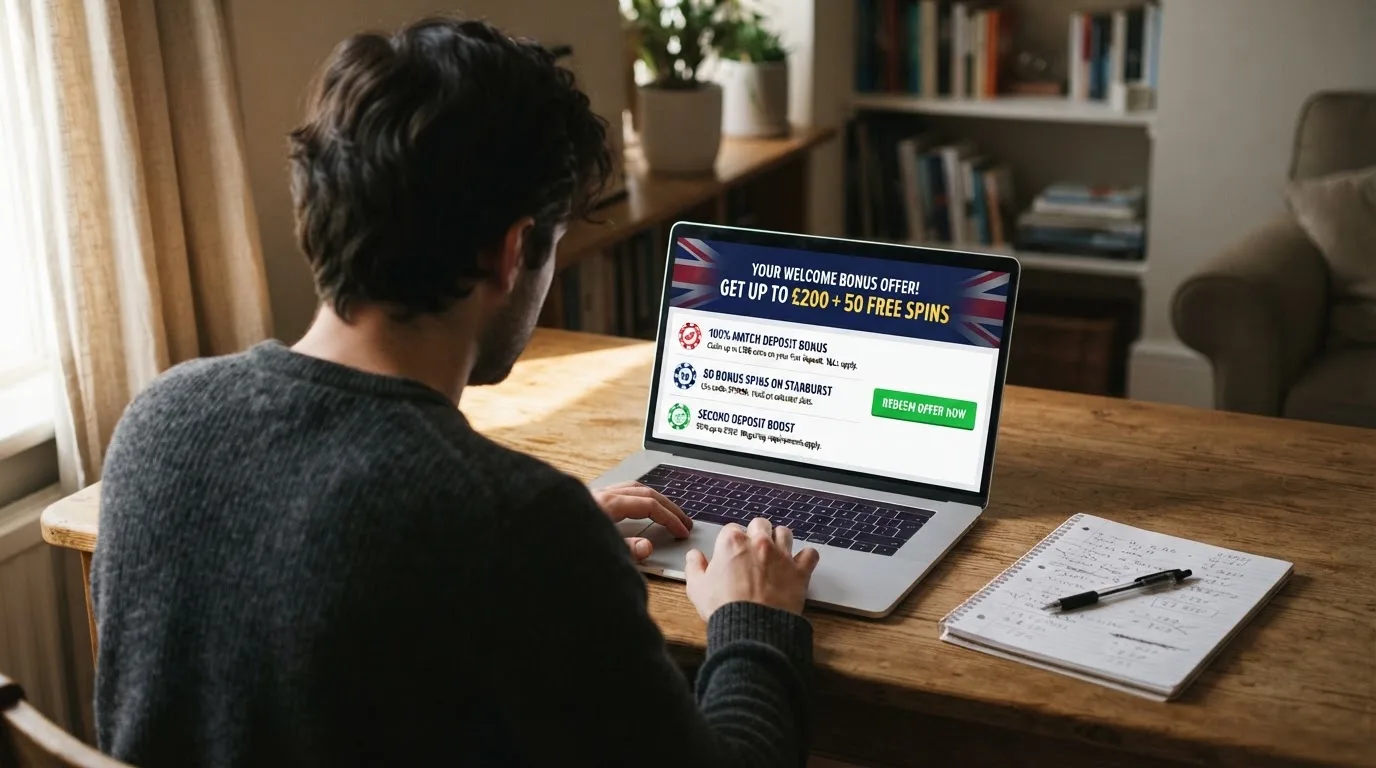
The terminology is small and worth learning once. Bonus funds sit in a separate balance from real cash and cannot be withdrawn until the wagering requirement is met. Wagering means the cumulative amount you must stake, not the amount you must deposit; a £100 bonus with a 10x requirement means £1,000 of qualifying bets before any of the bonus balance becomes withdrawable cash. Game weighting cuts that number further: slots usually count 100% towards wagering, but table games and live casino often count 10% or nothing, which multiplies the effective turnover required on those titles. A max bet rule caps the size of any single wager while the bonus is active; exceeding it usually voids the bonus and any winnings from it. An expiry date limits how long the bonus remains claimable.
These are the moving parts. Two offers that look identical on the headline banner can require very different amounts of play to convert, and the gap is what the wagering requirement, the game weighting and the max bet together decide. The next section is where the licensing frame around those terms is set.
Why the Gambling Commission licence changes the calculation
Every operator that takes customers in Great Britain needs a Gambling Commission licence, no matter where the company itself is incorporated. The Gambling (Licensing and Advertising) Act 2014 closed the loophole under which an overseas licence had been enough; a Curaçao, Maltese or Gibraltar registration is not a substitute for a Commission licence when British customers are involved. Section 33 of the Gambling Act 2005 makes providing gambling to people in Great Britain without a Commission licence a criminal offence, and the Commission uses cease-and-desist notices, search-engine delisting and payment referrals to disrupt sites that breach it.

The licence is the mechanism that produced the 10x cap. The Commission’s social responsibility code, the Licence Conditions and Codes of Practice (LCCP), sets the rules every licensee has to follow, and the December 2025 amendment put a ceiling on the wagering multiple that had previously been set by the operator alone. Mixed-product bonuses — an offer that gives a casino bonus in return for a sports bet — were banned in the same change. The same code produced the rules players meet at the cashier: the credit-card ban from 14 April 2020, the £5 maximum stake per game cycle for over-25s (from 9 April 2025) and £2 for the 18–24 cohort (from 21 May 2025), and the auto-play ban in force since 31 October 2021.
The licence is also the route to a complaint when something goes wrong. A player with an unresolved dispute at a licensed operator can take it to an approved alternative dispute resolution (ADR) provider; an unlicensed site offers no equivalent route, and the Commission’s own enforcement arm does not adjudicate individual disputes. That is the practical value the licence carries beyond the headline: the offer is regulated, the dispute route exists, and the player has somewhere to go when the operator does not answer.
The 10x cap, and what it actually costs to clear a bonus
The standard wagering requirement at UK-licensed casinos dropped to 10x of the bonus amount from 19 December 2025. That is the ceiling, and most operators sit close to it. To see what the cap means in play, take a representative bonus of £100 at the maximum 10x requirement and the smallest reasonable spin size of £0.10.
The required turnover is £100 multiplied by 10, which is £1,000 of qualifying bets. At a £0.10 spin that produces 10,000 individual spins. At the Commission’s minimum spin interval of 2.5 seconds, those spins take 25,000 seconds of play, which is roughly 6.9 hours of continuous play. Slot RTP at UK-licensed sites sits broadly in the 94–97% band, so the expected loss over those 10,000 spins at £0.10 each is £1,000 multiplied by (1 minus an RTP of, say, 96%), which is £40. That £40 is the statistical cost of clearing the bonus, before any free-spin value is added back in.
The same shape, scaled: a £200 bonus requires £2,000 of turnover, 20,000 spins, around 13.9 hours of play and an expected loss of around £80 at the same RTP. A £50 bonus requires £500 of turnover, 5,000 spins, about 3.5 hours of play and an expected loss of around £20. The expected-loss band across the £50–£200 range is therefore roughly £20 to £80 at the cap, depending on the bonus size and the slot’s RTP. Lower wagering multiples — some operators run 5x or even 1x on free-spin winnings — sit at the bottom of that band; the 10x cap sits at the top.
Three caveats carry equal weight to the arithmetic. The expected loss is an average over many spins; it is not a guaranteed outcome, and the variance of a slot session is wide enough that the same bonus can return a small profit or a much larger loss for any individual player. Free spins bundled into the offer add value that the calculation above does not credit, and the value of those spins varies with the slot’s RTP and any winnings-cap that applies to them. Max-bet rules usually sit at £5 while the bonus is active, the same figure as the over-25 stake cap, which means the ceiling is real but does not change the calculation for the small-stake player this page is built around.
The no-deposit version, and why it is rarer than the marketing suggests
A no-deposit sign-up bonus credits the new account before any money has changed hands. It is the offer the marketing language reaches for first, because it sounds like free money, and it is the offer the Commission has narrowed down most aggressively.
A no-deposit offer still carries wagering requirements, usually set higher per pound of bonus than a deposit match, since the operator is giving up real money before the player has risked any. It almost always carries a maximum cashout cap — a ceiling on the amount of bonus winnings that can ever be withdrawn, sometimes as low as £20 or £50, regardless of how much a player wins during the wagering. Free spins with no deposit have the same shape, often with an even tighter winnings cap. The headline still reads “no deposit needed”; the small print is where the offer ends.
What the research showed is that none of the ten GB-licensed operators examined for this page carries a no-deposit sign-up bonus on the register snapshot consulted. That is not a market-wide claim — no-deposit offers exist at UK-licensed sites in general — but it is the picture the featured set presents. Where one does appear, the comparison to make is straightforward: divide the maximum cashout by the wagering requirement to see the effective cost per pound of bonus, and read the winnings cap as the ceiling on what the offer can ever return. Anything that sounds generous against that ceiling is the marketing talking, not the terms.
What the credit-card ban and Faster Payments mean at the cashier
Two payment rails shape the cashier at every UK-licensed casino. The credit-card ban, in force from 14 April 2020, removes a funding source the Commission judged to be carrying problem gamblers disproportionately: in its 2018 survey, around 22% of online gamblers who used credit cards to fund play were classed as problem gamblers. The ban extends to credit cards routed through e-wallets, so the workarounds that initially appeared were closed off. Debit cards and bank transfers were unaffected, and they remain the standard deposit method.
Faster Payments is the rail that most UK bank transfers run over. The scheme, operated by Pay.UK, runs 24 hours a day, seven days a week and most payments arrive instantly or within a couple of minutes, though transfers can occasionally take up to two hours. The scheme carries a £1,000,000 per-transaction limit, though individual banks commonly impose lower customer-level limits. For casino withdrawals, Faster Payments is what a debit-card cashout or a bank-transfer withdrawal routes through once the operator’s internal processing completes — the deposit can be instant, the withdrawal still has to clear the operator’s own queue before Faster Payments takes over. The Bank of England oversees the scheme’s stability and provides final settlement but does not process individual payments.
Apple Pay and Google Pay sit alongside the standard rails at many UK-licensed sites, and both rely on tokenisation: the real card number is replaced with a device-specific token, and a dynamic security code is generated for each transaction, which limits the exposure of the underlying card. AstroPay’s UK entity is authorised by the Financial Conduct Authority as an electronic money institution, which makes it a regulated option where supported, though support at a UK-licensed casino is narrower than for the cards-and-bank-transfer core. None of these are substitutes for the credit cards the Commission banned; they are the regulated routes around them.
Safer-gambling protections that arrive with the bonus
Three protections sit over every UK-licensed casino and arrive whether the player reads about them or not. GAMSTOP is the national online self-exclusion scheme, and joining it blocks the player from every GB-licensed online operator for six months, one year or five years; the period cannot be shortened once chosen. Every online operator has to check new accounts against GAMSTOP, and the scheme has been a mandatory condition of every online licence since 31 March 2020. Identity verification is the second: since 7 May 2019 every licensed operator has to verify name, address and date of birth before the first deposit or any play, which is why anonymous play is not possible at a licensed site. The third is the mandatory financial-limit prompt that took effect on 31 October 2025: the player is asked to set a deposit ceiling before the first deposit, and the deposit cannot proceed without one being recorded.
Financial vulnerability checks are layered on top. From 28 February 2025 operators run a check based on public data at £150 of net deposits in a rolling 30-day window, and a wider financial risk-assessment framework has been signposted but is not yet in force. A player can also impose their own limits — deposit, loss, wager, session time — and ask for time-out or self-exclusion at a single operator, all of which sit alongside the GAMSTOP ceiling. The National Gambling Helpline, run by GamCare, and the support services funded by GambleAware cover the human side of that frame.
The bonus does not sit outside this apparatus. Wagering requirements, game weighting and max-bet rules are enforced by the same licensee that has to honour a GAMSTOP registration, and an operator that breaches its social responsibility code faces regulatory action that goes well beyond the cost of any individual complaint. That is the structural reason the licence matters: the rules around the offer are the same rules as the rules around the player.
The ten GB-licensed operators on the public register
The table below lists ten operators on the Gambling Commission’s public register, each one carrying an active remote casino operating licence. The licence number, the licensee and the register domain status are taken directly from the Commission’s own CSV download of 18 September 2026. No sign-up bonus terms are listed, because the register does not carry them, and the page does not invent them.
| Brand | Licence holder | GB remote casino licence | Register domain status |
|---|---|---|---|
| Grosvenor Casinos | Rank Interactive (Gibraltar) Limited (acct 57924) | 057924-R-334666-005 | Active |
| Betfred | Petfre (Gibraltar) Limited (acct 39544) | 039544-R-319290-010 | Active |
| 32Red | Platinum Gaming Limited (acct 45322) | 045322-R-324275-019 | Active |
| BetVictor | BV Gaming Limited (acct 39576) | 039576-R-319370-028 | Active |
| William Hill | WHG (International) Limited (acct 39225) | 039225-R-319373-015 | Active |
| Virgin Games | Gamesys Operations Limited (acct 38905) | 038905-R-319430-022 | White label |
| Ladbrokes | LC International Limited (acct 54743) | 054743-R-330863-014 | Active |
| Paddy Power | PPB Games Limited (acct 39411) | 039411-R-319335-010 | Active |
| Betfair | PPB Games Limited (acct 39411) | 039411-R-319335-010 | Active |
| Jackpotjoy | Gamesys Operations Limited (acct 38905) | 038905-R-319430-022 | Active |
Three things the table makes visible. Several brands share a single licensee: Ladbrokes sits under LC International Limited; Paddy Power and Betfair both run on the same PPB Games Limited licence; Virgin Games and Jackpotjoy both run on the Gamesys Operations Limited licence, with Virgin Games listed as a white-label domain — a site that trades under another company’s licence rather than its own. The register’s domain count on 18 September 2026 was 1,065 active and 361 white-label entries, which puts these ten brands inside a much wider commissioned set. None of them is described here as independent from its licensee, and that is a structural point about the UK market, not a quirk of the table.
What each licence actually obliges the operator to do
Holding a remote casino operating licence is not a one-off registration. The LCCP sets the operating standards; the Remote Technical Standards set the technical ones; and both are enforced through compliance assessments, mystery-shopper exercises and the routine reporting the Commission can demand at any time. The licence is held by a single legal entity — the account holder named on the register — and the domain running against it has to match, which is why a brand change or a platform migration has to be reflected back to the Commission.
Three obligations matter most for the reader of this page. The first is the affordability and vulnerability framework: the operator has to run the checks described above, and the Commission can require evidence that they have run them. The second is the marketing code: bonus terms have to be presented clearly, significant conditions cannot be hidden behind a hyperlink, and the wagering cap and the mixed-product ban are enforced as LCCP conditions. The third is the segregation of player funds: customer balances have to be kept in accounts separate from the operator’s own funds, with a stated level of protection — basic, medium or high — that the player can read before depositing.
A licence can be suspended or revoked. The Commission publishes enforcement action on its website, and a brand that has had a licence condition varied or a personal licence held against a director can be read directly on the register. The 139 active remote casino operating licence holders on the register as of 18 September 2026 are not a permanent set; the register is current, and the page is checked against it.
Reading a sign-up bonus offer against the terms
A bonus offer worth examining is one whose terms are short, specific and consistent with the LCCP. Three things to look for, in order. The wagering requirement, stated as a multiple of the bonus (or bonus plus deposit, where allowed), should be at or below the 10x cap, and the cap applies to the bonus only, not to the deposit. The game weighting should be stated, and slots at 100% is the standard; anything heavier than that on the headline game should be flagged. The max bet while the bonus is active should be the same as the stake cap that applies to the player’s age cohort — £5 for over-25s, £2 for 18–24 — and any lower max bet should be read as a real restriction on the play pattern needed to clear.
Then the secondary terms. Expiry dates on the bonus itself, on the wagering requirement and on any free-spin bundle all matter; an offer with a 30-day wagering window behaves differently from a 7-day one. Maximum cashout caps on free-spin winnings or no-deposit bonuses are common and can be tight. Game restrictions list which titles contribute to wagering and which do not, and live casino is often excluded entirely or counted at a low weighting. Withdrawal-method restrictions during bonus play — a rule that deposits must be turned over once before a withdrawal is allowed — are common at UK-licensed sites and worth reading before the deposit, not after.
What the offer cannot legally contain is also worth knowing. A wagering requirement above 10x would breach the LCCP. A mixed-product bonus (sports bet leading to casino credit) is banned. A credit-card deposit method is banned. A bonus that requires the player to opt out of safer-gambling tools or to deposit more than the deposit limit they set for themselves cannot be enforceable. None of these absolve the player of reading the terms, but they do set a floor.
The arithmetic behind a representative £100 bonus
Working through a £100 deposit-match bonus at the 10x cap, with a £0.10 spin and an RTP in the middle of the band:
- Required turnover: £100 multiplied by 10 is £1,000.
- Number of spins at £0.10: 10,000.
- Time at 2.5 seconds per spin: 25,000 seconds, which is about 6.9 hours.
- Expected loss at 96% RTP: £1,000 multiplied by 0.04, which is £40.
That £40 is the statistical cost. A free-spin bundle of 100 spins at £0.10 with 96% RTP returns an expected £4 of the £10 wagered, which is closer to break-even on a generous reading; a winnings cap of, say, £20 on the free spins can sit below the expected value if the slot returns well. The total expected loss for the £100 bonus plus 100 free spins, on the assumptions above, sits in the £36–£46 band.
Scale that to a £50 bonus and the band tightens to roughly £18–£28 of expected loss. Scale to a £200 bonus and it widens to roughly £72–£92. The point of the band, rather than a single figure, is that the same offer has a different cost depending on the slot the player chooses: an RTP of 94% lifts the expected loss to around £60 for the £100 bonus; an RTP of 97% drops it to £30. Where the operator publishes the RTP on a specific title, the calculation can be tightened to that figure; where it does not, the 94–97% range is the working assumption.
Grosvenor Casinos
Grosvenor Casinos runs on the Rank Interactive (Gibraltar) Limited licence, account 57924, with the active remote casino licence 057924-R-334666-005 covering Grosvenor Casinos. The brand carries a physical-casino heritage that the online product extends rather than replaces, and the licence sits in the same Rank group that operates Mecca Bingo and other UK-facing brands. As an established multi-channel operator the safer-gambling infrastructure is mature, the deposit-limit prompt will fire before the first deposit, and the GAMSTOP integration is in place.
What is not on the register is any sign-up bonus term. A brand that runs an offer will publish it on the site itself, not on the Commission’s register, and the offer can change weekly. The structural read is that this is a low-friction operator for a player who values the physical-casino tie-in and the multi-channel account over headline bonus size.
Betfred
Betfred sits on Petfre (Gibraltar) Limited, account 39544, with licence 039544-R-319290-010 active on Betfred. The Betfred brand is best known on the high street, where it carries a long retail bookmaking history, and the online casino runs alongside a substantial sportsbook under the same licence. The dual-vertical structure is a marker: any casino bonus will sit inside the LCCP’s mixed-product prohibition, and a casino-only offer is what the player should look for rather than a sports-casino bundle.
The licence holder is a Gibraltar company, which is common in this market and unremarkable under the post-2014 regime. What the licence confirms is the regulated status; what it does not confirm is any specific sign-up offer, which has to be read from the operator’s own promotions page at the point of claiming.
32Red
32Red runs on Platinum Gaming Limited, account 45322, with licence 045322-R-324275-019 covering 32red. Platinum Gaming is the operating entity behind the 32Red brand group, which has a long-standing position in the UK online casino market. The brand’s reputation in the segment is built around a relatively contained game library and a tighter operator profile than the multi-vertical bookmakers, which can read as focus or as narrower choice depending on what the player wants.
The licence status on the register is straightforwardly active. The sign-up offer is whatever 32Red is publishing at the point of account creation, and the same wagering-cap, no-mixed-product and safer-gambling rules apply.
BetVictor
BetVictor sits on BV Gaming Limited, account 39576, with licence 039576-R-319370-028 active on BetVictor. BV Gaming is the operating company behind BetVictor, with a casino and sportsbook under the same corporate roof. As with the other multi-vertical operators, the relevant LCCP rule for a casino bonus is that the offer has to be a casino-only product; a sportsbook-led promotion with a casino tail would breach the December 2025 mixed-product ban.
The brand has a long UK-facing history. The licence is current and the domain is active on the register. The sign-up bonus, like every other brand on this list, is read from the operator’s own terms at the point of claim rather than from the Commission’s register.
William Hill
William Hill is on WHG (International) Limited, account 39225, with licence 039225-R-319373-015 covering William Hill. WHG (International) is the operating entity behind the William Hill brand, which is one of the larger UK-facing gambling groups. The 888 takeover of the William Hill international operations sits in the background of the corporate structure, but the licence account on the Commission’s register is the entity that holds the obligation to the LCCP.
A player comparing William Hill to the rest of this set is comparing a large multi-vertical group against the same kind of group: the casino offer is one product inside a wider portfolio, and the safer-gambling framework applies across all of them. The register is the source of truth for the licence; the offer is read from the site.
Virgin Games
Virgin Games runs as a white-label domain of Gamesys Operations Limited, account 38905, with licence 038905-R-319430-022. A white-label listing on the register means Virgin Games trades under Gamesys’s licence rather than holding its own; the brand is a marketing front, the licensee is Gamesys. The same licence covers Jackpotjoy further down the list.
White-label does not mean unregulated. The LCCP obligations, the GAMSTOP integration and the deposit-limit prompt all bind the licensee, and Gamesys is the entity the Commission holds to account. What it does mean is that a dispute or a query routes to Gamesys rather than to the brand, and the registered player base sits under a single operational account.
Ladbrokes
Ladbrokes is on LC International Limited, account 54743, with licence 054743-R-330863-014 active on Ladbrokes. LC International also covers Coral and Gala Bingo under the same group structure, all running against the same licence account. As with the other multi-vertical groups, the casino sign-up offer has to be a casino product in its own right, not a sportsbook-led bundle.
The combined group is one of the largest UK-facing operators, and the licence account has been an active remote casino licence holder for the period covered by the register. The sign-up bonus is whatever Ladbrokes is publishing at the time; the licence confirms the regulated status.
Paddy Power
Paddy Power runs on PPB Games Limited, account 39411, with licence 039411-R-319335-010 active on Paddy Power. PPB Games also covers Betfair under the same licence account, which makes the two brands operationally a single entity in the eyes of the Commission while remaining separate marketing propositions to the player.
A player comparing Paddy Power and Betfair is comparing two brands on one licence, which means the safer-gambling tools, the payment rails and the LCCP framework are identical at the back end; the difference is the front-end product, the game mix and any brand-specific promotion. The Commission’s register is the same in both rows of the table.
Betfair
Betfair is the second PPB Games Limited brand, account 39411, with licence 039411-R-319335-010 active on Betfair. The exchange heritage gives Betfair a different product mix from a pure casino operator, and the casino vertical sits alongside the sportsbook and exchange products under the same licence. The casino sign-up offer, like every other brand on this page, is read at the point of claim rather than from the register.
What the shared licence with Paddy Power means in practice is that any change to the operating account — a variation, a suspension, an enforcement action — affects both brands. The Commission’s register carries the licence, not the brand, which is why the two rows of the table carry identical licence data.
Jackpotjoy
Jackpotjoy is the second Gamesys Operations Limited brand, account 38905, with licence 038905-R-319430-022 active on Jackpotjoy. Jackpotjoy sits alongside Virgin Games under the same licence account, and the brand has a longer-running position in the UK bingo-and-casino segment than Virgin Games.
The structural read is the same as the other white-label and shared-licence brands: the LCCP and the GAMSTOP framework bind the licensee, and the brand is a marketing proposition on top of that framework. The sign-up offer is published on the site, not on the register, and the comparison to make is on the offer terms rather than the licence status.
What the comparison actually comes down to
Once the licence status is set aside as a baseline — all ten brands on this list hold an active remote casino operating licence with the Commission, and that fact is the entry ticket to the comparison — the choice between them turns on what each operator’s sign-up offer actually delivers. The 10x wagering cap sets a ceiling, not a floor; some operators run their bonuses at well below 10x, and the lower the multiple, the cheaper the bonus is to clear. Game weighting, max-bet rules, free-spin RTP and any winnings cap on the free-spin bundle move the effective cost up or down inside that frame.
A player with a small bankroll is better served by a lower bonus at a lower multiple than by a higher bonus at the cap, because the expected-loss band scales with the bonus size. A player who plays slots regularly can read the free-spin bundle as material value, especially where the named slot has an RTP above 96%. A player who plays table games should read the game-weighting table carefully, because a 10% contribution on roulette can multiply the effective turnover required by ten. None of these reads is on the register; all of them are on the operator’s own terms page, and the licence is what guarantees that the page is enforceable rather than aspirational.
What an offer cannot legally look like in the UK
Three shapes are off the table at a GB-licensed casino, and the licence is the reason. Wagering requirements above 10x breach the LCCP and would expose the operator to compliance action; the same applies to a mixed-product bonus that rewards a sports bet with casino credit. A credit-card deposit method is banned across all online and offline gambling in Great Britain since 14 April 2020, with the e-wallet routing closed off at the same time. Anonymous play is not possible: the operator has to verify name, address and date of birth before the first deposit or any play, which is the same data that GAMSTOP is checked against.
These rules are part of the licence, not a marketing choice. A player who finds an offer that looks as if it sits outside any of them is looking at an unlicensed site, where the Commission’s protections do not apply: no GAMSTOP, no ADR route, no enforced safer-gambling tools, and no recourse to the regulator when a withdrawal stalls. The register is the test of whether a brand holds a licence, and the register is public.
Frequently asked questions about UK casino sign-up bonuses
What counts as the best casino sign-up bonus in the UK right now?
The “best” offer is the one whose total cost, after wagering requirements and free-spin terms, is lowest for the player’s actual stake size. The 10x cap is the ceiling, not the floor, and some operators run well below it; a smaller bonus at a lower multiple can clear for less than a larger bonus at 10x. The licence status of the operator is a precondition, not a tiebreaker.
Does a UK casino need a Gambling Commission licence to offer a sign-up bonus?
Yes. Any operator taking customers in Great Britain needs a Commission licence, no matter where the company itself is incorporated, and the licence is what binds the operator to the LCCP, the wagering cap and the safer-gambling framework. A Curaçao, Maltese or Gibraltar registration is not a substitute for the Commission licence where British customers are involved.
Is a no-deposit sign-up bonus different from a deposit-match sign-up bonus?
Yes. A deposit match unlocks bonus credit against the first deposit and is the more common shape. A no-deposit bonus credits the account before any money has changed hands, and is usually smaller, comes with a tighter winnings cap and is rarer at GB-licensed sites than the marketing language suggests. Both carry wagering requirements.
How much wagering applies to a typical sign-up bonus under the UK’s current cap?
The cap from 19 December 2025 is 10x of the bonus amount, and most licensed operators sit at or close to that ceiling. A £100 bonus at the cap means £1,000 of qualifying bets before the bonus balance becomes withdrawable cash, which is roughly 10,000 spins at a £0.10 stake and about 6.9 hours of continuous play.
Does a sign-up bonus expire if it is left unused?
Yes. Most sign-up bonuses carry an expiry date on the bonus itself and a separate window on the wagering requirement, commonly 7 to 30 days. A free-spin bundle usually expires faster than the bonus balance, and any unused bonus or spins are forfeit at the end of the window. The exact dates are on the operator’s terms page.
Can a sign-up bonus be claimed more than once on the same account?
No. A sign-up bonus is a one-per-customer offer, tied to the verified identity on the account. Creating a second account to claim the same bonus is a breach of the operator’s terms and a breach of the LCCP’s identity-verification rules, and any winnings from the second account can be voided.