What a phone-credit deposit at a UK mobile casino actually costs
 Available in GB
A reader who types “best mobile casino pay with phone credit UK” into a search bar usually wants two things at once. They want a site that lets them put money in from a phone bill rather than a card, and they want to know whether the site doing it is one the Gambling Commission has signed off. Both questions are answered on this page, but the second matters more than the first: the route into a UK-licensed account runs through the regulator’s public register, and a deposit method sits on top of that licence, not in its place.
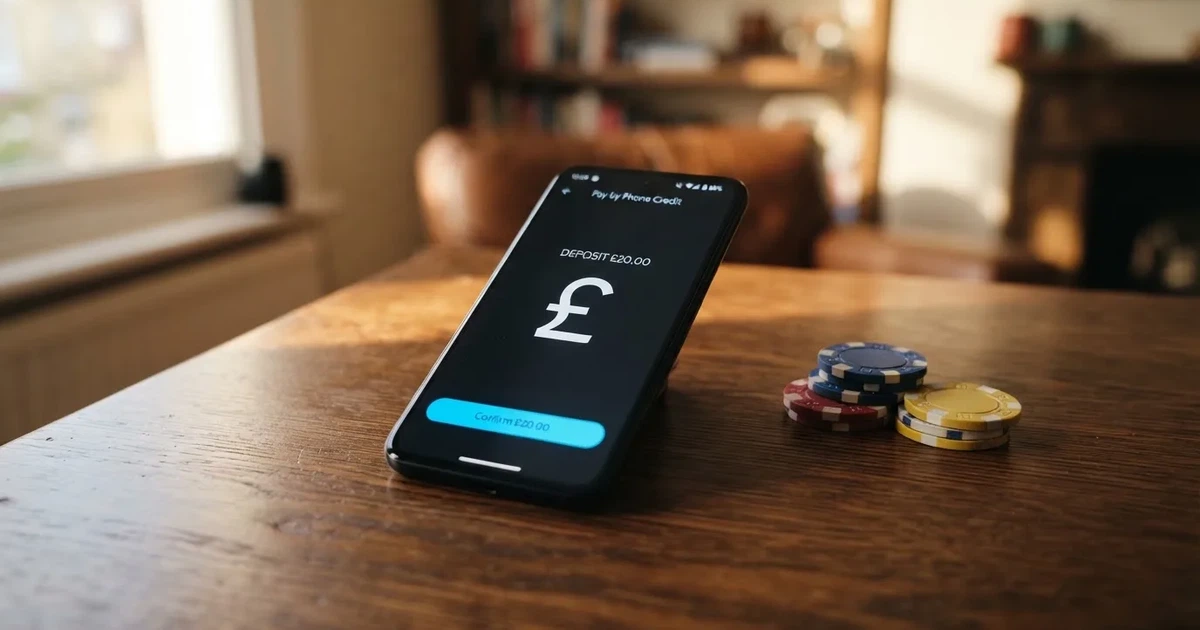
The angle here is cost. A phone-credit deposit is small, fast and easy to undo — that is the point of it, and it is also where the sharp edges live. The same ease that makes it a sensible first deposit makes it a poor place to chase a loss. The wider wagering cap that took effect on 19 December 2025 changes what bonuses cost the person paying for them. The stake limits that took effect across April and May 2025 change what one spin of a slot is worth. None of those rules is a marketing line. Each one decides how much money moves, and on whom, when the reels stop.
Currency stamp: figures current as of 23 September 2026, verified against the Gambling Commission’s public register of gambling businesses and the operator domains listed against it.
- The fundamentals of paying by phone credit at a UK casino
- Licensing and jurisdiction: what holding a Commission licence actually obliges
- Safer gambling around a phone-credit deposit
- Deposits, withdrawals and the speed of settlement
- What the new wagering cap does to the cost of a bonus
- The licensed set: ten GB-registered casino brands, compared side by side
- bet365 — the deepest cashier of the licensed set
- Betfred
- PokerStars
- 32Red
- Virgin Games
- William Hill
- Midnite
- Grosvenor Casinos
- 888casino — long-running casino brand under 888 UK
- kwiff — newer licence, single dedicated brand
- How to read this list against a phone-credit deposit
- What paying by phone does not do
- The £30 ceiling and the bonus cap in one number
- Frequently asked questions
The fundamentals of paying by phone credit at a UK casino
Paying by phone credit at a UK online casino is not a single product. It is a way of routing a deposit through the customer’s mobile network rather than a bank card. The most prominent UK scheme is Payforit, which grew out of work started in 2005 by the UK founders of the SimPay consortium and launched in 2007. SimPay itself had been founded earlier still — in February 2003, by four major carriers, as the Mobile Payment Services Association — and had ceased activity in June 2005. The carrier-billing model that replaced it has been live in UK retail for nearly two decades. A second route is Boku, a London-headquartered mobile carrier-billing and pay-by-mobile payments company founded in 2009. Boku processes payments by billing transactions directly to a customer’s mobile phone account, and the company itself states that it operates across more than 90 countries and supports more than 200 local payment methods through a single API across more than 40 markets.

For a casino player, what matters is the deposit. A player confirms a deposit amount at the casino cashier, the request is passed to the mobile network or to a mobile-billing aggregator, and the amount is added either to the player’s monthly phone bill or, on a pay-as-you-go contract, deducted from the available credit. The casino’s balance updates; the player’s phone account carries the charge. That is the whole of it, on the customer’s side, which is why the method appeals: no card to type, no app to open, no separate password to remember.
The wider UK online casino landscape sits behind that simple flow. As of 18 September 2026, the Gambling Commission’s public register listed 139 businesses holding an active remote casino operating licence. The same register’s domain list held 1,065 active and 361 white-label website entries on the same date — and a white-label site trades under another company’s licence, which is why a brand name alone is not enough to confirm a licence.
Licensing and jurisdiction: what holding a Commission licence actually obliges
The regulator is the Gambling Commission, sponsored by DCMS and operating under the Gambling Act 2005. That Act covers Great Britain — England, Scotland and Wales — and not Northern Ireland. Since the Gambling (Licensing and Advertising) Act 2014 came into force, any operator taking customers in Great Britain needs a Commission licence wherever the operator itself is based; a Curaçao, Maltese or Gibraltar licence is not a substitute for the GB one. The Commission’s public register is the test: each remote casino licence number has the form account-R-number-suffix, where the leading six digits repeat the licence holder’s account number and the “R” marks a remote (online) licence.
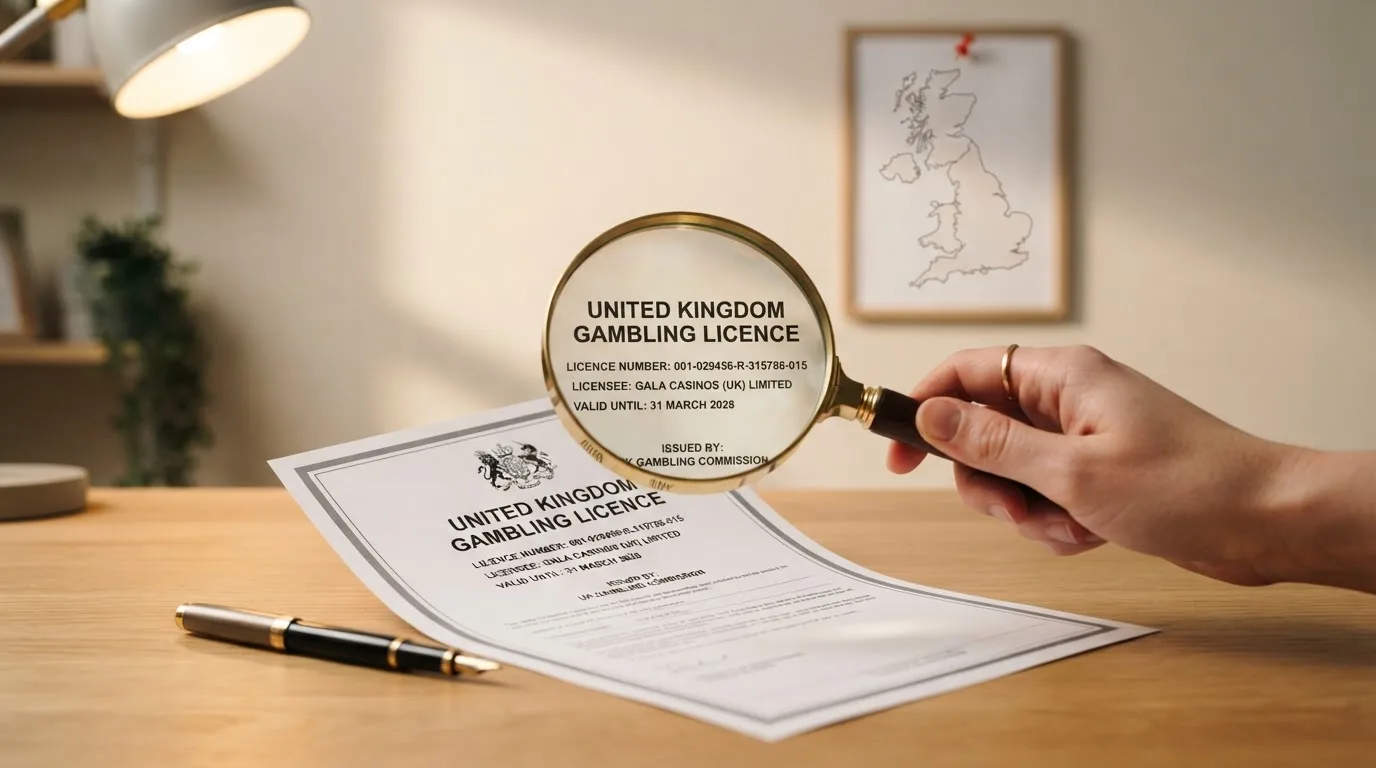
Holding that licence is not a paper exercise. Every GB-licensed online casino must verify the customer’s name, address and date of birth before the first deposit or any play — a position in force since 7 May 2019. From 31 October 2025 an operator must prompt a customer to set a financial limit before accepting the first deposit. Online slots carry a maximum stake per game cycle — £5 for players aged 25 and over (from 9 April 2025) and £2 for players aged 18 to 24 (from 21 May 2025). Auto-play is banned (since 31 October 2021), a slot spin may not complete faster than 2.5 seconds, and losses disguised as wins are banned. Credit cards have been banned for gambling since 14 April 2020, and that ban extends to credit-card-funded e-wallet deposits.
The two rules that bite hardest on a phone-credit deposit are the ID check and the financial-limit prompt. A customer who picks pay by phone because they do not want to type a card number still has to pass the same identity verification as everyone else, and still has to set a limit before the cashier will accept money. The phone network handles the deposit; the licence handles everything else.
Section 33 of the Gambling Act 2005 makes it an offence to provide gambling to people in Great Britain without a licence. The Commission disrupts illegal sites by issuing cease-and-desist notices, asking for search-engine delisting, and referring payment and hosting providers. It has no power to order ISP-level blocking, and no penalty falls on the player — but what a player loses at an unlicensed site is the whole protective layer: no GAMSTOP, no Commission complaints route, no approved ADR. That asymmetry is the strongest argument for sticking to the register, and it is the reason this page only names operators that appear on it.
Safer gambling around a phone-credit deposit
The safer-gambling architecture around a UK-licensed casino is the same whether the deposit comes from a card or a phone bill. GAMSTOP, the national online self-exclusion scheme, has been a mandatory condition of every online licence since 31 March 2020 — a customer self-excludes for six months, one year or five years, and the period cannot be cancelled early. From 28 February 2025 a financial vulnerability check runs at £150 net deposits in a rolling 30 days, using public data only; the wider financial risk assessments are announced but not yet in force. The National Gambling Helpline is run by GamCare, and GambleAware funds treatment and research across Great Britain.
A phone-credit deposit runs through that structure in the usual way, and on three points the method sits slightly differently from a card. The first is the daily cap. UK premium-rate telephone numbers used for pay-by-phone services carry a two-part charge — an access charge set by the caller’s phone company and a service charge set by the receiving organisation, with service charges capped between 7p per minute on 084x numbers and £3.60 per minute on 09xx numbers — and premium-rate SMS shortcodes beginning with 72 are reserved in the UK specifically for society lotteries. The relevant point for a casino deposit is the deposit ceiling set by the operator and the network: typically £30 a day on pay-as-you-go and £40 a day on contract, varying by provider. The second is reversal: a deposit billed to a phone bill can be disputed through the network, but the dispute is between the customer and the network, not the casino, and the funds are usually no longer in the casino account by the time the dispute opens. The third is the absence of a chargeback route: once a phone-credit deposit has funded play, recovering it is a complaints process, not a chargeback.
The limit prompt is the line that matters. A player who has set a financial limit at one site and then deposits at a second has not escaped the limit — operators exchange data through GAMSTOP and the financial vulnerability check, and a limit set voluntarily at one site is the kind of evidence a Commission complaints adjudicator weighs heavily. The point of setting a limit is not the number. The point is that the number is set before the deposit, by the person whose money it is.
Deposits, withdrawals and the speed of settlement
The route that money takes in and out of a UK-licensed casino is a different conversation from the route that money takes around the customer’s phone bill. A phone-credit deposit moves fast: the cashier confirms the amount, the network confirms the charge, and the casino’s balance updates in seconds. The Commission does not set a minimum settlement time, but the practical effect is near-instant. The £30-or-so daily ceiling is the only thing that slows it, and only because the customer has to ask for the next deposit rather than typing a number into a card field.
The deposit side has one further quirk worth naming. Day-to-day regulation of UK premium-rate phone-paid services transferred from the Phone-paid Services Authority back to Ofcom from 1 February 2025, so the regulator on the network side is now Ofcom rather than the Phone-paid Services Authority. The Commission still regulates the casino. Two regulators, two complaints routes, and the customer’s complaint is whichever one covers the failure: the casino, the cashier, the network billing aggregator, or all three.
The withdrawal side is slower and is not a phone-credit transaction at all. No UK-licensed casino pays out to a phone bill — withdrawals go back to a bank account, an e-wallet or, in a small number of cases, a card that originally funded the deposit. The Commission’s social responsibility code requires operators to confirm source of funds before a withdrawal that takes a customer over a threshold, and the operator’s own internal ID and source-of-funds checks run before settlement. Once those are clear, the practical speed of a withdrawal is set by the operator’s own payouts team and by the receiving bank. Same-day withdrawals are increasingly common at the larger UK-licensed brands, but “instant” is a marketing word that hides the ID check behind it.
What the new wagering cap does to the cost of a bonus
On 19 December 2025 the Commission brought a new rule into force: wagering requirements on bonuses are capped at 10x, and mixed-product bonuses — an offer that pays a casino bonus for a sports bet, for example — are banned. The cap sits on the multiplier the operator attaches to the bonus, and it has the practical effect of bounding what a customer has to spend to clear an offer. The result is a band, not a figure: a £10 bonus at 10x means £100 of turnover; a £30 bonus at 10x means £300; a £100 bonus at 10x means £1,000. Each one is a multiple of the bonus amount, and each one is a budget the customer commits before any of it is theirs to withdraw.
What the cap does not do is remove the house edge. The turnover the customer has to generate is still turnover on games that have an RTP below 100%. The expected loss on a £100 bonus cleared at the 10x cap, on a slot paying 96%, is £100 × 10 × (1 − 0.96) = £40 — four times the face value of the bonus. The cap lowers the multiplier; it does not turn a bonus into a profit. Reading a “10x” headline as “easy to clear” is the mistake the cap was written to soften, and softening is what it does: a 30x or 40x bonus would have cost more.
For a phone-credit deposit specifically, the cap matters because the deposit itself is small. A £30 phone-credit deposit with a £30 bonus at 10x means £300 of turnover. On a £0.10 spin at 96% RTP, that is 3,000 spins; at 2.5 seconds per spin, that is roughly 2 hours 5 minutes at the reels. The arithmetic is not the question. The question is whether two hours of slot play is worth a £30 bonus at the end of it, and the answer for most readers is that the bonus pays less than the time costs.
The licensed set: ten GB-registered casino brands, compared side by side
The ten brands below all appear on the Gambling Commission’s public register as GB-licensed remote casino operators. The table records the licence holder, the licence number and the domain status on the register. None of the entries carries a pay-by-phone-credit confirmation on the register itself; phone-credit support is a cashier-level integration that is not recorded at licence level. The table therefore reports the licence truthfully, and leaves the payment method to the operator’s own cashier page — which is the only place that information lives.
| Brand | Licence holder | GB remote casino licence | Domain status on the register | Pay-by-phone credit |
|---|---|---|---|---|
| bet365 | Hillside (UK Gaming) ENC | 055149-R-331499-004 | Active | — |
| Betfred | Petfre (Gibraltar) Limited | 039544-R-319290-010 | Active | — |
| PokerStars | Stars Interactive Limited | 039108-R-319334-026 | Active | — |
| 32Red | Platinum Gaming Limited | 045322-R-324275-019 | Active | — |
| Virgin Games | Gamesys Operations Limited | 038905-R-319430-022 | White Label | — |
| William Hill | WHG (International) Limited | 039225-R-319373-015 | Active | — |
| Midnite | Dribble Media Limited | 042647-R-321653-022 | Active | — |
| Grosvenor Casinos | Rank Interactive (Gibraltar) Limited | 057924-R-334666-005 | Active | — |
| 888casino | 888 UK Limited | 039028-R-319297-014 | Active | — |
| kwiff | Eaton Gate Gaming Limited | 044448-R-323408-017 | Active | — |
The single white-label row in the set is Virgin Games, whose domain trades under Gamesys Operations Limited’s licence; the rest are active domains against their own licence accounts. The licence holders behind the table are the legal customer of the Commission, not the brands that appear in the cashier — a distinction that matters when a complaint is filed, because the Commission replies to the licence holder, not the brand. A player who has a complaint about Virgin Games is in substance making it about Gamesys Operations Limited.
The column on pay-by-phone credit is empty across the board, and intentionally so. The Commission’s register does not record which payment methods an operator offers. What it confirms is that each of these brands is licensed to take a GB deposit at all, which is the prerequisite to offering any method. The next step — confirming that the cashier at a specific brand carries a phone-billing option — is the operator’s own page, and that check has to be done by the player, at the cashier, before the deposit.
bet365 — the deepest cashier of the licensed set
bet365 is listed on the Gambling Commission’s public register as an active domain of account 55149, Hillside (UK Gaming) ENC, which holds the active remote casino operating licence 055149-R-331499-004. The depth of the cashier is what sets it apart from the rest of the licensed set: bet365 runs a payments page with more deposit methods than most of its peers and a withdrawal queue that, for verified accounts, often completes the same day. For a player whose priority is the size of the cashier rather than the speed of any single route, bet365 is the brand the others are measured against. The pay-by-phone-credit support on the cashier is what it is; what the licence confirms is that the cashier exists at all, and is regulated when it does.
Betfred
Betfred operates as an active domain under licence holder Petfre (Gibraltar) Limited (account 39544), which holds the active remote casino operating licence 039544-R-319290-010. The high-street name carries over to the online product, and the licence is single — the same account number sits behind Betfred’s sportsbook, casino and bingo. A player who already has a Betfred shop account and wants a single online identity will find that the online product does not need a second sign-up; the GB-licensed status means GAMSTOP applies and the same self-exclusion covers both. The phone-credit deposit on the cashier is what Betfred decides to offer; the licence confirms that the cashier is regulated, and that the £150 net-deposit vulnerability check will run across Betfred and any sister site.
PokerStars
PokerStars runs as an active domain under licence holder Stars Interactive Limited (account 39108), which holds the active remote casino operating licence 039108-R-319334-026. The brand’s reputation is in poker; the casino product is younger, but it runs under the same licence and the same safer-gambling infrastructure. A player who joins Stars Interactive for poker and then opens the casino tab has not changed operator — Stars Interactive Limited is the legal customer of the Commission across both. The phone-credit deposit is offered or not at the cashier; what the licence guarantees is that the cashier is held to the same LCCP and social responsibility code as the poker client.
32Red
32Red (32red) operates as an active domain under licence holder Platinum Gaming Limited (account 45322). The licence-holder name is the relevant one for complaints and dispute resolution; the brand name is the relevant one for the cashier. The set is small — 32Red is one of the cleanest examples in the licensed set of a brand whose casino product runs under a single dedicated licence rather than a shared group structure. A player who values a tight one-brand, one-licence relationship has 32Red as the cleanest match.
Virgin Games
Virgin Games is a white-label domain of account 38905, Gamesys Operations Limited. A white-label site trades under another company’s licence, which means the legal customer of the Commission for Virgin Games is Gamesys Operations Limited, not any Virgin entity. The distinction is practical rather than theoretical: a complaint filed with the Commission about Virgin Games is filed against Gamesys. The cashier is Virgin’s; the regulated entity is Gamesys’s. A player who values brand familiarity over licence clarity finds Virgin Games straightforward; a player who wants to know exactly which regulated entity sits behind the cashier needs to read past the brand.
William Hill
William Hill runs as an active domain under licence holder WHG (International) Limited (account 39225). The licence is one of the older entries on the register, and the cashier at William Hill reflects that maturity — the deposit-method list is long and the withdrawal queue is established. A player who treats the cashier as the deciding factor, and who wants a brand with a long compliance history behind it, has William Hill as a baseline. The phone-credit option is what the cashier offers on the day; the licence confirms that the cashier is regulated.
Midnite
Midnite operates as an active domain under licence holder Dribble Media Limited (account 42647), which holds the active remote casino operating licence 042647-R-321653-022. Dribble Media Limited is a younger licence-holder than most of the set, and Midnite is its principal brand. A player who prefers a tighter operation — one brand, one licence-holder, one cashier — has Midnite as the kind of match the older multi-brand groups are not. The pay-by-phone support is whatever the cashier shows; the licence confirms that Midnite is held to the full social responsibility code, including GAMSTOP and the financial vulnerability check.
Grosvenor Casinos
Grosvenor Casinos operates as an active domain under licence holder Rank Interactive (Gibraltar) Limited (account 57924). The land-based heritage of the Grosvenor brand carries into the online product: the same safer-gambling obligations apply, and a player who self-excludes through GAMSTOP is excluded from the online site as much as from the physical casinos. The cashier is online-only; the licence is online-only; the safer-gambling ties to land-based play run through GAMSTOP. A player who has used Grosvenor’s physical premises and wants continuity online has the brand; the licence confirms the continuity is regulated.
888casino — long-running casino brand under 888 UK
888casino is listed on the Gambling Commission’s public register as an active domain of account 39028, 888 UK Limited, which holds the active remote casino operating licence 039028-R-319297-014. The 888 brand has been in the UK online casino market longer than most of the set, and the licence is held by a UK-incorporated entity — 888 UK Limited — rather than a Gibraltar- or Isle of Man-incorporated one. The cashier has the depth that comes with the brand’s age; the phone-credit support is the cashier’s call. For a player who prefers a UK-incorporated licence holder, 888 UK Limited is the relevant entity, not the wider 888 group.
kwiff — newer licence, single dedicated brand
kwiff is listed on the Gambling Commission’s public register as an active domain of account 44448, Eaton Gate Gaming Limited, which holds the active remote casino operating licence 044448-R-323408-017. Like Midnite, kwiff runs as a single brand under a single licence-holder. A player who wants a smaller operation with a focused cashier — rather than the cross-brand catalogue of the larger groups — has kwiff as one of two matches in the set (the other being Midnite). The phone-credit deposit on the cashier is what Eaton Gate Gaming Limited has integrated; the licence confirms the integration is held to the standard Commission code.
How to read this list against a phone-credit deposit
The list above is a list of GB-licensed remote casino operating licences, not a list of phone-credit deposit options. The register does not record payment methods, and the cashier at any of these ten brands may or may not carry a pay-by-phone option on the day a player visits. What the register confirms is that each brand has cleared the Commission’s licence test: identity verification before first deposit, GAMSTOP enrolment, the £150 net-deposit vulnerability check, the financial-limit prompt before first deposit, and the source-of-funds check before a large withdrawal. Those are the obligations that hold whether the deposit came from a card or a phone bill.
For a player who wants a phone-credit deposit, the practical order is the cashier page. The Commission register settles the question of which brands are licensed to take a GB deposit at all; the cashier settles which of those brands will accept that particular method. Reading the table above as a shortlist, the next step is to visit the cashier at two or three of the brands and look for the phone-billing option directly.
What paying by phone does not do
Paying by phone credit at a UK mobile casino is a deposit method, not a protection. It does not raise the RTP of a slot, lower the wagering multiple on a bonus, exempt the player from the £150 vulnerability check, or place the deposit outside the financial limit the player set on first deposit. It does not give the player any special withdrawal route — withdrawals go back to a bank, an e-wallet or a card, not to the phone bill. It does not give the player any extra complaint route — the network and the casino are the two regulators, and neither replaces the Commission’s complaints process for licensed play.
What it does is small. It puts a £30-or-so daily ceiling on the deposit. It bills the deposit to the phone bill rather than the bank statement. It removes the card number from the cashier. For a player who values any of those three things, the method is worth using. For a player who wants it to do more than it does, it is worth understanding what it cannot do first.
The £30 ceiling and the bonus cap in one number
Take the daily phone-credit ceiling and the new wagering cap together. A £30 phone-credit deposit with a £30 bonus at 10x means £300 of turnover. On a £0.10 spin at 96% RTP, that is 3,000 spins; at 2.5 seconds per spin, that is 7,500 seconds, or 125 minutes, or about 2 hours 5 minutes at the reels. The expected loss on those 3,000 spins is £300 × (1 − 0.96) = £12. The bonus is worth £30 if the player clears it; the cost of clearing it is £12 in expected loss. Net expected value: £30 minus £12, minus the time it costs.
The figure is a band, because the bonus amount is what the operator offers, and the wagering multiple is what the rule caps — both are bounded, but neither is fixed at one number for every offer. The point of the arithmetic is to make the cost visible, not to commit it to one number. A reader who knows the band can read the next offer they see and apply the same shape to it: bonus × 10 = turnover; turnover × (1 − RTP) = expected loss. The rest is the player’s call.
Frequently asked questions
How does paying by phone credit work at a mobile casino?
The player picks the phone-billing option at the cashier, confirms the amount, and the deposit is routed through the mobile network — either to the player’s monthly phone bill or deducted from pay-as-you-go credit. The casino balance updates in seconds. No card number is typed; no e-wallet is involved. The deposit is small, typically capped around £30 a day on pay-as-you-go and £40 a day on contract, and the same identity verification still runs before the first deposit because the licence requires it.
Is a pay-by-phone-credit deposit added straight to a phone bill?
Yes — on a contract account it is added to the next monthly bill, and on a pay-as-you-go account it is deducted from the available credit at the time of the deposit. The route is through the mobile network or through a mobile-billing aggregator such as Payforit or Boku, and the charge appears as a phone-paid service line on the customer’s statement rather than as a card transaction.
Do UK-licensed casinos still run ID checks before a phone-credit deposit?
Yes. The Commission’s social responsibility code requires name, address and date-of-birth verification before the first deposit or any play, in force since 7 May 2019, and that applies to every deposit method including phone credit. From 31 October 2025 the operator must also prompt the customer to set a financial limit before accepting the first deposit. Picking a method that does not require a card number does not exempt the player from either step.
Is there usually a limit on how much can be deposited by phone credit?
Yes. The typical daily ceiling on a UK phone-credit casino deposit is around £30 on a pay-as-you-go SIM and around £40 on a contract, set by the network and the operator together. The ceiling is the same on every licensed brand — it is set at the network level, not the casino. For larger deposits the player has to use a card or an e-wallet; the phone-credit route is designed for small, fast deposits rather than for topping up a balance by hundreds of pounds.
How quickly does a phone-credit deposit reach a casino account?
In seconds. The cashier confirms the amount, the network confirms the charge, and the casino balance updates without an intermediate clearing step. The Commission does not set a minimum settlement time on the deposit side; the practical delay is the network’s, not the regulator’s. Withdrawal is a different question — withdrawals go back to a bank or e-wallet, not to the phone bill, and the speed of a withdrawal is set by the operator’s payouts team and the receiving bank after ID and source-of-funds checks are clear.
Can phone-credit deposits be reversed if made by mistake?
The dispute route runs through the mobile network rather than through the casino. Once a phone-credit deposit has funded play, the funds are usually no longer in the casino account, and recovering them is a complaints process with the network and the operator — not a chargeback. The Commission recommends contacting the casino’s customer-support team first; if the response is unsatisfactory, the operator’s approved ADR is the next step, and the Commission’s complaints team is the route above that.
Created by the ”cardcasinoguide” editorial team.