Best online casino game shows in the UK for 2026
 Available in GB
The “game show” format took live casino somewhere it had not been before. A presenter, a wheel or a card shoe, a studio built for cameras, and a payout table that looks nothing like the one at a blackjack table. Eight years on from the first title, the format is its own shelf on every UK-licensed site, and it sits under rules the Gambling Commission started tightening in January 2025.
Currency stamp: data current as of 23 September 2026, cross-checked against the Gambling Commission’s public register.
- What a “live casino game show” actually is
- The licensing frame every UK operator works under
- Safer-gambling rules that apply to a live game show
- The titles worth knowing on a UK-licensed site
- How the bonus arithmetic lands after the 10x cap
- Comparing ten UK-licensed sites on the live game show shelf
- What separates one GB-licensed site from another on live game shows
- Reading the licence number when a brand claims to be UK-licensed
- What the live game show category will look like for the rest of 2026
- What to confirm before staking on a live game show
- Frequently asked questions
What a “live casino game show” actually is
The category starts with a wheel and a presenter, and the rest follows from there. Evolution’s Dream Catcher, launched in 2017, built the template: a vertically mounted wheel with 54 segments, 52 of them numbered (1, 2, 5, 10, 20 or 40) and two acting as multipliers (2x and 7x). Players bet on the segment the wheel will stop on; the multipliers boost the payout of any number they land on. A live host runs the round. That wheel-plus-presenter combination became the scaffolding for the rest of the category — MONOPOLY Live and Deal or No Deal Live arrived in 2019, Crazy Time in 2020, Funky Time in 2023.
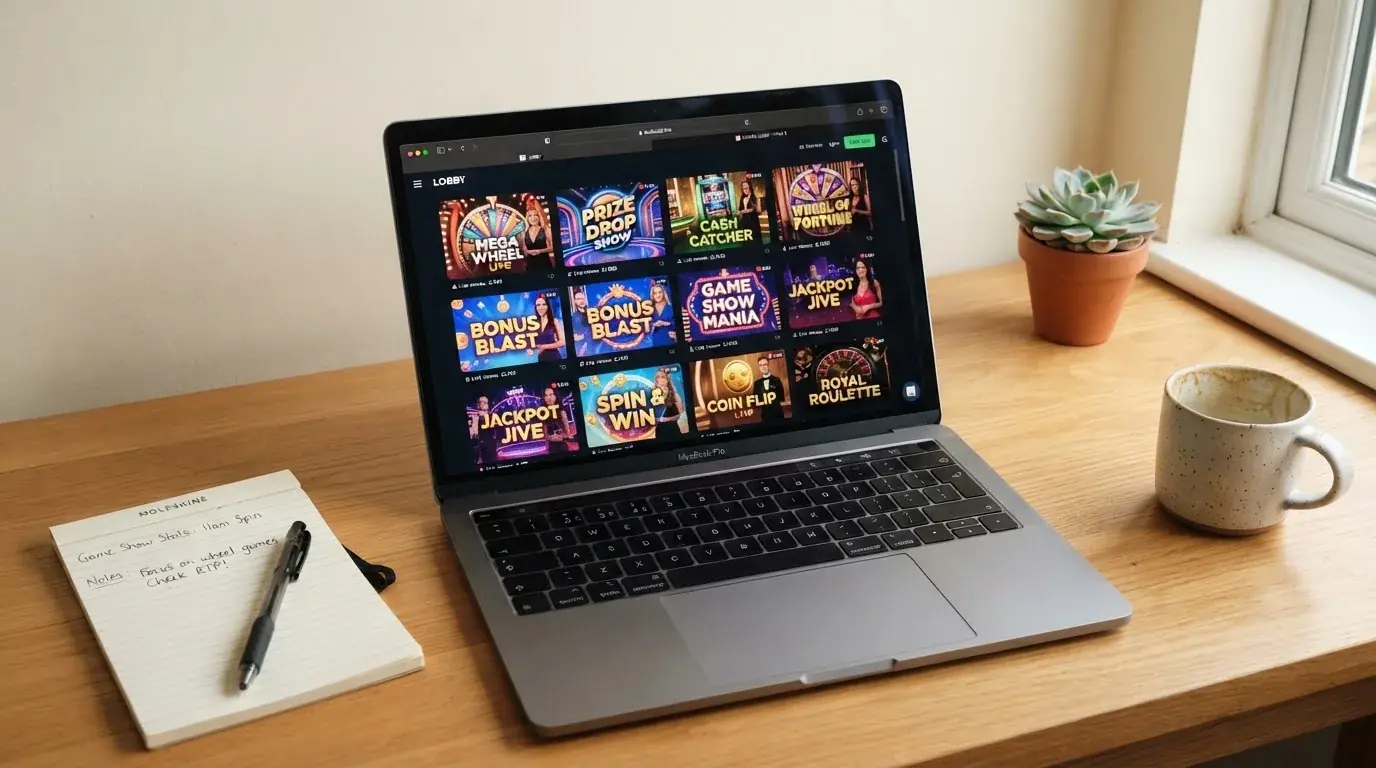
The format matters because it changes what the player is paying for. A standard live table game is built on a shoe and a dealing rhythm; the player weighs odds, takes a card or doesn’t. A game show sits closer to a broadcast: studio lighting, a host reading out a winner’s name, sound effects when a multiplier lands, an on-screen tracker showing recent results. The betting underneath is still a casino product with a house edge, but the surface is television.
A handful of game shows sit outside the wheel template. Aviator, a crash-style game from Spribe, runs a multiplier curve that rises from 1.00x until the round randomly crashes; a player must cash out before the crash to win their stake times the current value. Spribe’s CEO has called it the first true multiplayer crash game in the regulated iGaming space, and the studio says Aviator now reports more than 42 million active users and processes around 350,000 bets per minute across more than 5,000 operators worldwide. The curve format is its own beast, and the safer-gambling rules apply to it the same way they do to a wheel.
The licensing frame every UK operator works under
UK online casino runs under the Gambling Act 2005, with the Gambling Commission as regulator. A remote casino operating licence is the only legal route to take real-money bets from customers in Great Britain; a Curaçao or Malta licence is not a substitute, and an offshore site has no GB licence to look up. The Commission’s public register is the proof: on 18 September 2026 it listed 139 businesses holding an active remote casino operating licence. Each licence number follows the format account-R-number-suffix, where the leading six digits repeat the licence holder’s account number and the “R” marks a remote (online) licence.

The register also tracks domains. A single licence can list many sites — both fully run and white-label (a white-label trades under another company’s licence). On that same 18 September 2026 the domain list held 1,065 active entries and 361 white-label entries. The number of active GB-licensed sites is bigger than any single review can cover, and the page below narrows it to ten brands that show up across the UK live game show category — chosen because each appears in the register and each carries an active remote licence.
Two further pieces of the frame set the cost of doing this on a UK site. First, since 14 April 2020, credit cards cannot be used to fund gambling, and routing a credit card through an e-wallet is not a way around it. Second, since 19 December 2025, wagering requirements on bonuses are capped at 10x and mixed-product bonuses (bet on sport, get casino spins) are banned. The 10x cap is the figure to keep in mind whenever an offer is on the table: at 10x, a £30 bonus needs £300 of qualifying turnover before any of it can be withdrawn. That arithmetic runs in its own section below.
Safer-gambling rules that apply to a live game show
The Commission’s remote technical standards that took effect on 17 January 2025 extended rules that previously covered online slots to other online gaming products — game shows included. Three of them are worth knowing before the first bet.
Auto-play is banned. The feature existed in some form on live products before the rule; it is now off the menu on every GB-licensed site. A round proceeds only because the player presses to start it.
Wins that are not really wins cannot be celebrated. The standard requires that auditory and visual effects used to mark a return cannot run when that return is less than or equal to the player’s total stake — a “loss disguised as a win”, the kind of celebration a slot reel used to trigger, is not permitted on a live game show either. The on-screen cheering still happens when a multiplier lands, but a stake returned at the same value does not get the same fanfare.
Net position has to be visible. Live products must display information on a player’s net spend and net time in play, so the session cost is on screen at all times.
There is also the wider UK frame the live game show sits inside:
- A minimum age of 18, with name, address and date of birth verified before the first deposit and before any play.
- GAMSTOP self-exclusion (six months, one year or five years, cannot be cancelled early) is a condition of every GB online licence since 31 March 2020.
- Operators must prompt a player to set a financial limit before the first deposit, in force since 31 October 2025.
- Financial vulnerability checks run at £150 in net deposits across a rolling 30-day window using public data only, in force since 28 February 2025.
- A ban on reverse withdrawals has been in force since 31 October 2021 — funds requested to withdraw cannot be sent back into play.
- Credit cards have been banned for gambling since 14 April 2020.
A separate stake tier applies to online slots and does not, in its current form, attach to live game shows: players aged 25 and over face a £5 maximum stake per game cycle on slots from 9 April 2025, and 18–24-year-olds face £2 from 21 May 2025. The UK government has cited the highest average problem-gambling score among 18–24-year-olds, alongside lower disposable income and ongoing neurological development, as the rationale for the lower slot tier. None of that transfers onto a live game show today, but it shows how the regulator treats a game cycle when it decides one product carries more risk than another.
The costs of using an unlicensed site, for a player who drifts off the register, are worth stating in one place: no GAMSTOP, no Commission complaints route, no approved alternative dispute resolution. The Commission’s powers against illegal sites run to cease-and-desist notices, search-engine delisting, and payment and hosting referrals — it has no ISP-blocking power. No penalty falls on the player. What the player loses is the protection.
The titles worth knowing on a UK-licensed site
The “Game Shows” category on a live casino lobby is short on format and long on branding. Five titles carry most of the traffic.
Dream Catcher is the prototype. Wheel-based, 54 segments, the payout on a numbered segment is the stake times the segment’s number; the 2x and 7x segments double or septuple any number they share a stop with. Launched in 2017 by Evolution, it is still the cheapest live game show to follow on a screen because the betting grammar is one number at a time.
MONOPOLY Live keeps the wheel but adds a two-reel bonus round that drops players onto a 3D MONOPOLY board with Mr Monopoly walking around it, collecting rent, landing on Chance, and paying out as multipliers stack. The math is the same wheel underneath; the presentation is a slot’s.
Deal or No Deal Live is the game show built from the television programme. Players qualify for the top round by spinning a three-reel bank vault through multiplier tiers; once inside, they work through briefcases against a “banker” offer. The wheel and the qualifying bank are the casino mechanics. The briefcases are the broadcast.
Crazy Time is the most complex of the wheel-based game shows, and the one with the most bonus rounds. The main wheel splits payouts across numbers, Coin Flip, Cash Hunt, Pachinko, and Crazy Time itself; in the bonus rounds, a Top Slot above the wheel adds a global multiplier that can change a low payout into a substantial one.
Funky Time, a 1970s disco-themed wheel game launched in 2023, sits closest to Crazy Time in structure but with a different aesthetic. The wheel splits payouts across numbered segments and four bonus games; a live DJ booth on the studio floor doubles as the bonus trigger for one of them.
Each title sits under a return-to-player figure that varies by bet type. Published RTPs in this segment of the market are not always carried in headline terms — they appear in game info panels on the live lobby of every UK-licensed site, where the bet-specific payout tables sit alongside. Treat any quoted RTP as a long-run average, not a session promise; the house edge on a game show is the house edge on the specific bet placed.
Aviator sits apart. Its 1.00x-to-crash curve is a different format from a wheel, and the safer-gambling rules above still apply — auto-play off, net position displayed, the same age and identity verification on the way in. The mechanic is simpler: pick a stake, watch the multiplier climb, hit cash out before the crash. The catch is the same as every other casino product: the crash can come at 1.01x.
How the bonus arithmetic lands after the 10x cap
The 19 December 2025 wagering cap at 10x is the line the rest of the bonus arithmetic walks up to. A bonus with a 10x wagering requirement means the player must wager ten times the bonus amount in qualifying bets before any of the bonus (and the winnings it produced) becomes withdrawable.
The math, for a £30 bonus at the cap:
- Qualifying turnover: £30 × 10 = £300.
- Spins at a £1 stake: 300 spins.
- At 5 seconds per round: 300 × 5 = 1,500 seconds, or about 25 minutes of continuous play.
That is the lower band: small bonus, £1 stake, single-handed play. Two things move it:
- Bonus size: the turnover moves with the bonus. A £100 bonus at 10x means £1,000 of qualifying turnover; a £300 bonus means £3,000.
- Stake per round: a live game show rounds at the table’s minimum stake, which can sit at £0.10, £0.50 or £1. Lower stakes spread the rounds out across more spins and more time; higher stakes compress them.
What the cap removes is the older market, where a 35x or 50x wagering requirement was standard. A 35x bonus on the same £30 needed £1,050 of play to clear — three-and-a-half times the post-cap figure. The 10x ceiling does not make a bonus free; it makes the cost of clearing it legible at the outset.
What the cap does not change is the house edge during the clearing. The 10x wagering requirement is the volume of play needed, not the expected loss. On a wheel game with a published RTP of around 96%, expected loss on £300 of turnover sits at roughly £12 (turnover × 1 − RTP, all else equal). That figure sits on top of the £30 already paid in as a bonus, and it is the real cost of clearing the offer. Higher stakes shorten the wall clock; they do not change the house edge.
The cleared result is still subject to a maximum-cashout cap where one applies. The 10x ceiling on wagering does not remove a max-cashout rule on the offer itself, and that cap — where the operator has set one — is the figure that decides whether the bonus clears to a real withdrawal or to a partial one. Read the offer terms; the cap sits in the small print and not on the headline.
Comparing ten UK-licensed sites on the live game show shelf
The table below lists ten brands that hold an active GB remote casino operating licence on 18 September 2026. Each domain is checked against the Commission’s register; the licence number is the one the register prints against the licence holder’s account. Several of the brands share a single licence holder — Virgin Games and Jackpotjoy both sit under Gamesys Operations Limited, for instance — so what looks like ten competing brands is in places a single operator with multiple skins.
| Brand | Licence holder | GB remote casino licence | Domain status on register | Game show support |
|---|---|---|---|---|
| Virgin Games | Gamesys Operations Limited | 038905-R-319430-022 | White-label domain | — |
| Betfred | Petfre (Gibraltar) Limited | 039544-R-319290-010 | Active domain | — |
| Betfair | PPB Games Limited | 039411-R-319335-010 | Active domain | — |
| Sky Vegas | Bonne Terre Gaming Limited | 065519-R-339675-002 | Active domain | — |
| Gala Bingo | LC International Limited | 054743-R-330863-014 | Active domain | — |
| 32Red | Platinum Gaming Limited | 045322-R-324275-019 | Active domain | — |
| Casumo | Recro Limited | 061549-R-336718-002 | Active domain | — |
| Midnite | Dribble Media Limited | 042647-R-321653-022 | Active domain | — |
| PokerStars | Stars Interactive Limited | 039108-R-319334-026 | Active domain | — |
| Jackpotjoy | Gamesys Operations Limited | 038905-R-319430-022 | Active domain | — |
The dashes in the final column are deliberate. Game show availability is set by the studios a site integrates, not by its licence, and no public register entry records which Evolution, Pragmatic Play Live or Spribe titles a given operator has wired into its lobby. Confirming the catalogue means opening the live casino tab at each brand and looking — a step the register cannot do for a reader. The dash is the honest answer; a guess would be worse.
What the register does record, on every row, is the licence. Every brand above is licensed to take remote casino bets in Great Britain; every one is required to take part in GAMSTOP, to verify identity before the first deposit, and to apply the technical standards of 17 January 2025 to its live game show products. That is the floor, not a recommendation. Choosing among them is a separate decision, and the licence number on a row does not decide it.
Virgin Games
Licence: 038905-R-319430-022, held by Gamesys Operations Limited. Virgin Games is listed on the Commission’s register as a white-label domain of account 38905 — meaning the brand is operated under Gamesys’ licence rather than running its own.
A white-label arrangement is a licensing note, not a quality judgement. The same game show studios can run on a white-label site as on a fully-licensed one; the licence holder is responsible to the Commission either way, and the player protections attached to the licence follow the licence. What a white-label mark on the register tells a reader is which company to look up in the complaints chain.
Virgin Games, like Jackpotjoy below, sits in the Gamesys portfolio. Picking one over the other is a question of which brand’s interface the player prefers, not which licence they are playing under.
Betfred
Licence: 039544-R-319290-010, held by Petfre (Gibraltar) Limited. Betfred.com is an active domain on the register.
Betfred carries the longest-standing bookmaker brand on the list, which translates into a casino product that has spent years fitting alongside the sportsbook. The live casino lobby on Betfred carries the wheel-based game shows as part of a wider table-game offering; the live game show category is one tab among several rather than the first thing a player sees on opening the lobby.
Betfair
Licence: 039411-R-319335-010, held by PPB Games Limited. Betfair.com is an active domain on the register.
Betfair runs its casino under the same parent company that runs the exchange, which means the casino product sits in a wider gambling ecosystem of sports betting, exchange and poker. Game show titles here operate under the same licence and the same safer-gambling controls as the rest of the casino product.
Sky Vegas
Licence: 065519-R-339675-002, held by Bonne Terre Gaming Limited. Skyvegas.com is an active domain on the register.
Sky Vegas is a casino-only brand under Sky’s wider umbrella. A player coming for live game shows gets the casino lobby without the sportsbook adjacent to it. The licence number is newer than some of the others on the list — the format stays the same, but the issuing year differs.
Gala Bingo
Licence: 054743-R-330863-014, held by LC International Limited. Gala Bingo is an active domain on the register.
Gala Bingo runs under LC International Limited, the same parent that holds licences for Ladbrokes and Coral. This brand pairs its wheel-based game titles with a bingo-first product, letting players move between the two in a single lobby.
32Red
Licence: 045322-R-324275-019, held by Platinum Gaming Limited. 32red is an active domain on the register.
32Red is one of the older casino brands on the list, and the licence has the kind of suffix (019) that suggests several renewals since the original issue. A live game show on 32Red runs in a casino-focused lobby rather than a sports-and-games one, and the same technical standards apply.
Casumo
Licence: 061549-R-336718-002, held by Recro Limited. Casumo.com is an active domain on the register.
Casumo runs its product as a casino-first brand with a loyalty layer built into the lobby. A live game show on Casumo sits alongside slots and table games, with the same identity and deposit controls the rest of the site enforces.
Midnite
Licence: 042647-R-321653-022, held by Dribble Media Limited. Midnite.com is an active domain on the register.
Midnite is a newer brand on the list, with a casino product that launched alongside its sportsbook. A live game show on Midnite is one tab in a casino lobby that itself sits next to a sports product. The licence holder is Dribble Media Limited.
PokerStars
Licence: 039108-R-319334-026, held by Stars Interactive Limited. Pokerstars.uk is an active domain on the register.
PokerStars.uk is the casino product bolted onto one of the largest poker brands in the world. The live casino tab carries the standard wheel-based titles; the casino runs under a separate UK-facing licence at Pokerstars.uk rather than the .com domain.
Jackpotjoy
Licence: 038905-R-319430-022, held by Gamesys Operations Limited. Jackpotjoy.com is an active domain on the register.
Jackpotjoy shares its licence number with Virgin Games — both sit under Gamesys Operations Limited at account 38905. A player opening Jackpotjoy or Virgin Games is, from the Commission’s perspective, playing on the same licensed estate, with the same GAMSTOP enrolment and the same identity-verification steps.
What separates one GB-licensed site from another on live game shows
The licence does most of the differentiation. Every site above is required to verify identity before the first deposit, to enrol the player in GAMSTOP, to apply the 17 January 2025 technical standards to game show products, and to honour the £150-net-deposit financial vulnerability check. The differences that remain are in the surface: which studios each lobby integrates, what the live casino tab looks like, what the brand carries alongside the wheel.
Three practical differences worth weighing:
Catalogue breadth. A site that integrates Evolution, Pragmatic Play Live and OnAir Entertainment will carry more game show titles than one that integrates only Evolution. The category as a whole is dominated by Evolution’s wheel products (Dream Catcher, MONOPOLY Live, Crazy Time, Funky Time, Deal or No Deal Live), with Pragmatic Play Live and other studios adding their own wheels and crash games. The live casino tab on each brand is the only way to confirm.
Interface. A wheel game show plays the same regardless of the brand running it, but the betting interface — chip selection, bet confirmation, history view — varies. A player who intends to play a hundred rounds a session notices the difference.
Bonus terms. Every bonus on every UK-licensed site is now capped at a 10x wagering requirement, and mixed-product bonuses are banned. The shape of the offer that remains (a casino-only bonus, a free-spins-style offer on a specific game show, a deposit match with a low wagering factor) varies by site, and the small print on each is the figure that decides the real cost. The register does not record bonuses; the operator’s terms page does.
Reading the licence number when a brand claims to be UK-licensed
A “UK-licensed” claim on a footer is only as good as the licence number printed with it. The format the Commission’s register uses is account-R-number-suffix, and the “R” marks a remote (online) licence. A row on the register confirms the licence holder’s company name (not always the trading name on the footer), the licence’s status, and the domain entries attached to it. If the licence number on a site footer does not appear on the register, the claim is unsupported.
Two practical checks:
- Search the register at gamblingcommission.gov.uk for the licence number. An active licence returns a record with the licence holder’s name, the trading names it covers, and the licence’s status.
- Search the register for the company name on the footer. The licence holder printed there should match the register entry. If it does not, the footer is misleading.
The Commission’s domain list adds a third check: a brand whose domain does not appear on the active list at all, but whose licence number does, may still be licensed — it may simply be operating under a different domain. The register is the test of both the licence and the domain.
What the live game show category will look like for the rest of 2026
Three things to watch.
The 10x wagering cap and the ban on mixed-product bonuses have been in force since 19 December 2025, and the offers on UK-licensed sites have had time to settle into the new shape. A reader who sees a casino-only offer with a 10x wagering requirement and a clear max-cashout cap is looking at the post-cap normal; an offer that does not match that shape is one to read twice.
Remote Gaming Duty, the operator-side tax on gross gaming yield, was raised from 21% to 40% from 1 April 2026. That increase lands on the operator’s side of the ledger, not the player’s, but it changes the margin an operator runs on the live casino category — and that change works through into which titles get prioritised in the lobby, which studios get the better integration deals, and which brands keep their live casino tab at full depth.
The technical standards of 17 January 2025 are still recent enough that some of their effects are still working through. The net-spend and net-time-in-play display requirement, the loss-disguised-as-a-win ban, and the auto-play ban are all visible to a player now. A standard or two further down the list — those addressing the format itself rather than the betting interface — is the kind of update a UK player should expect to see materialise in product notes during the next year.
Players pay no tax on gambling winnings in the UK. Operators pay Remote Gaming Duty. The cleanest reading of a live game show in 2026 is that the cost to the player sits in the wagering requirement, the stake, and the house edge on the title — not in any tax on winnings.
What to confirm before staking on a live game show
The decision sits in three places.
The licence number on the register, confirmed against the footer. If the licence number does not appear on the register, the rest of the comparison does not matter.
The terms on the offer. The 10x cap is the ceiling; a lower factor is the floor. A max-cashout cap is the ceiling on what the bonus clears to. A mixed-product bonus does not exist anymore under GB rules, and any offer that crosses sports and casino is one to walk away from.
The bet on the wheel. The published RTP on the specific bet placed (a single number, a multiplier, a bonus round) is the only honest figure for what the bet returns over time. The game info panel on the live lobby prints it; the rest of the page does not.
The arithmetic above is the floor. A £30 bonus at the 10x cap means £300 of qualifying turnover, 300 spins at £1, and about 25 minutes of continuous play. The expected loss on £300 of turnover at a 96% RTP sits at roughly £12. Those figures are the average over many spins; they are not a guarantee on a single session, and the next round can crash the curve at 1.01x.
Frequently asked questions
What is a live casino game show, and how is it different from a table game?
A live casino game show is a real-money casino game presented from a studio with a live host, built around a wheel, a card-based game, or a multiplier curve rather than a dealing shoe. A standard live table game (roulette, blackjack, baccarat) is built around the betting grammar of the table; a game show is built around a broadcast format with a presenter and a payout table designed for television. The safer-gambling rules under the Gambling Commission’s remote technical standards apply to both.
Are live casino game shows streamed from a real studio?
Yes. The wheel and the host are in a studio, the camera feed is live, and the betting interface runs alongside the broadcast. A round cannot start without a player pressing to begin, which keeps the round under the player’s control even when the format looks like a TV show.
Do UK-licensed sites publish odds or payout structures for game shows?
Yes. The game information panel on the live casino tab of every GB-licensed site carries the payout table for the title, including the per-bet RTP. The figures are long-run averages; a single session does not return the published rate.
Can a bonus be used to play a live casino game show?
Where the operator’s bonus terms allow. Since 19 December 2025 the wagering requirement on any GB-licensed bonus is capped at 10x, and mixed-product bonuses are banned, so a live-game-show bonus today is a casino-only offer with a maximum 10x wagering factor. The terms page on the offer prints which titles count towards the wagering requirement.
Is a live casino game show hosted by a real presenter?
Yes. The category is built around a live host running the round — calling out winners, triggering bonus rounds, and reading the multiplier. The host is the surface the format runs on; the betting underneath is still a casino product.
Are live casino game shows covered by the same licence as slots on the same site?
Yes, where the operator holds a single remote casino operating licence for the whole product. A remote casino licence covers slots, live game shows, table games, and any other online gaming product the operator offers; the 17 January 2025 remote technical standards apply across those products, not just to slots.
Written by the editors at cardcasinoguide.