The UK field for Betsoft slots in 2026: ten Gambling Commission brands, weighed honestly
 Available in GB
Data current as of 23 September 2026 and checked against the Gambling Commission’s public register of gambling businesses.
The question behind this guide is simple. The list of Betsoft slots and the list of casinos licensed to offer them in Great Britain overlap, but they are not the same list, and the gap matters more than it looks. A Betsoft title on a casino’s lobby may be reachable in two clicks; what stands between a UK player and that slot are a Commission licence, a GAMSTOP check, age and identity verification, and a stake ceiling that no promotional banner mentions. This guide walks the perimeter of that question and lays out ten operators that pass it — Betfred, Jackpotjoy, William Hill, kwiff, PokerStars, Ladbrokes, Paddy Power, Unibet, Virgin Games and Casumo — without dressing any of them up as the place to play.
- What Betsoft actually ships to a UK lobby
- Reading a paytable and a bonus round
- Mobile play without an app
- The ten operators in this ranking
- The legal frame around Betsoft play in the UK
- How GAMSTOP fits into the picture
- Crypto, Bitcoin and the question of “no verification”
- Payments, payout speed and the practical order
- Welcome bonuses, free spins and the 10x rule
- The cost of a Betsoft bonus in real time
- Betfred
- Jackpotjoy
- William Hill
- kwiff
- PokerStars
- Ladbrokes
- Paddy Power
- Unibet
- Virgin Games
- Casumo
- Verdict across the ten
- How a UK player picks from this set in practice
- FAQ
What Betsoft actually ships to a UK lobby
Betsoft Gaming has been building slot software since 2006 and now runs a portfolio of more than 200 RNG titles across slots, table games, video poker and specialty games. The studio holds testing certifications from the Italian gambling authority ADM, Gaming Labs International and Quinel — three accreditation routes that matter more to a UK operator’s compliance officer than to a player. What the player sees is a slots catalogue with a recognisable visual signature: 3D-rendered character art, layered bonus rounds, and a recent branding push around a “THE” series of narrative-driven games released on 12 January 2026 (THE VIP, THE Game Show, THE Oil Barons, THE Governor, THE Robbery). Two follow-up releases — Good Girl Bad Girl 2 and Gold Nugget Rush 2 — sit alongside that series. Distribution has stepped up: Betsoft went live on bet365 Italy on 14 August 2025, and its parent company runs an active Great Britain Remote Gambling Software licence under the trading name Bet Software (PTY) Ltd, licence number 050689-R-328022-004, in force since 21 February 2018.

That combination tells a UK player what they need to know without opening a single game’s paytable: the studio has the regulatory paperwork, the supply chain reaches British shores, and the recent release schedule is fresh enough that a casino which hasn’t refreshed its Betsoft tab in eighteen months is showing the wrong list of titles.
Reading a paytable and a bonus round
A Betsoft slot is, mechanically, the same shape as any other modern video slot: reels, paylines or ways-to-win, a base game, and at least one bonus feature. The studio’s reputation sits in the bonus round — a free-spins feature with multipliers, a pick-and-click, a cascading-reels mechanic, or some combination. “Engagement” is the marketing word, and what it actually means in this catalogue is feature density: a high-volatility game with two bonuses stacked into one feature, rather than the single scatter-triggered round that an older generation of slots offered.
Volatility is not published by Betsoft in a single index the way some studios publish RTP. A player who cares about variance has to read the individual paytable or take the studio’s word in marketing copy — which describes its own games generously by design. RTP figures, where the studio lists them, sit in the 95–96.5% band common to licensed UK slots, and individual titles can drift above or below that range. A session’s experience still comes down to the maths the regulator has approved, not the screenshots the studio posts.
UK players do not get to choose variance freely, either. Slots here run inside a stake ceiling — £5 per game cycle for players aged 25 and over, £2 for 18-24 — and that ceiling is the same irrespective of volatility class. A “high volatility” slot looks scarier in marketing copy than it plays at £2 a spin.
Mobile play without an app
Every brand on this list runs its lobby through a mobile browser. None of the ten reviewed brands pushes a dedicated downloadable app in the UK market as the primary way to reach its Betsoft catalogue, which suits the modern state of HTML5 slot design: Betsoft’s games run on the same browser engine that loads the cashier, the promotions page and the account menu, with no separate binary to update.
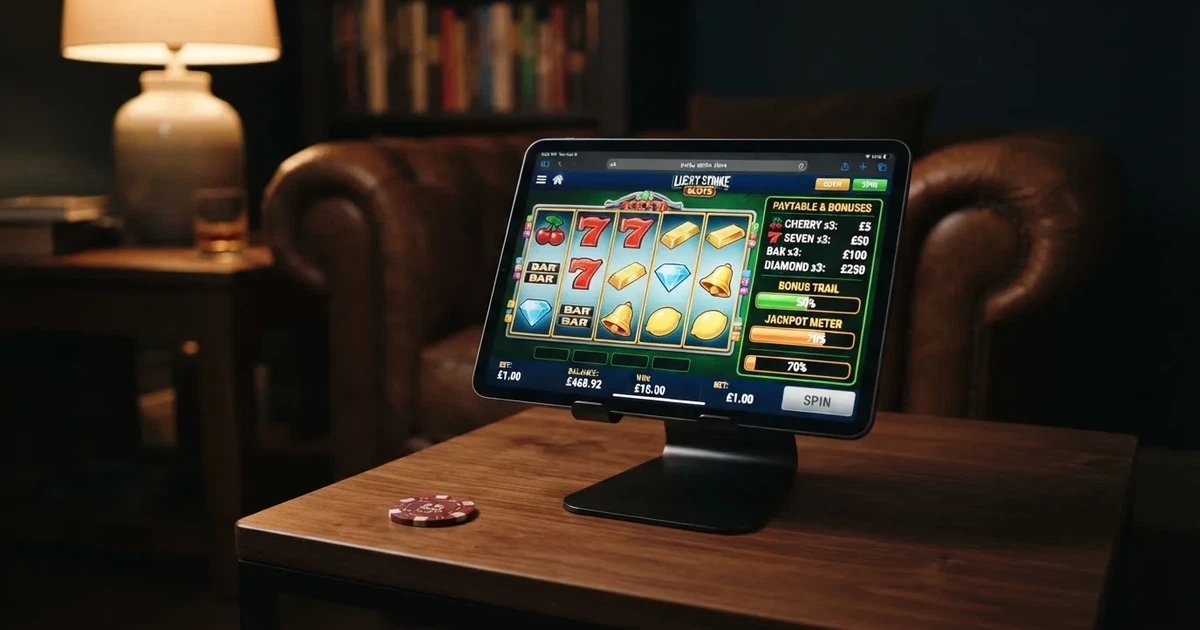
What that means in practice is that performance now depends on three things — the casino’s own web app, the studio’s game client, and the device’s browser — and the player feels the seam only when one of the three lags. The slot itself is largely the same experience: same reels, same paytable, same stake ceiling. What changes is orientation, since most Betsoft releases are landscape-first; portrait mode on a phone crops the reels or compresses the bonus-round overlay. A tablet, the traditional bridge device, is the form factor where the catalogue was designed to land — a tablet propped on a stand will show the full slot grid and the payout chart that sits beside it, where a small phone shows neither comfortably.
The other mobile question is data. A Betsoft round, like any modern HTML5 slot, streams game assets from the operator’s CDN and from the studio’s own content servers; the casino’s mobile web app caches some of it, but a fresh session cold-loads the rest. A player on a metered connection is paying for that load on every game change.
The ten operators in this ranking
A note on the comparison block below. Every row of the table is drawn from the Gambling Commission’s public register of gambling businesses, the same document any player can search at the Commission’s website. Brands can share one licence — three of the ten below (Ladbrokes, Virgin Games and a sister domain described in the licence notes) sit under licensees that hold more than one remote casino licence each, which is why the “Licensee” column sometimes repeats. A white-label domain on the register trades under another company’s licence; that matters because complaints, ADR routes and regulatory contact all run through the underlying licensee, not the trading name on the homepage. Subject support — whether a casino confirms Betsoft as one of the providers it carries — is not stated by every brand in a way the Commission’s register can verify, and rows without that data point are left quiet in the table.
| Brand | Licence holder and remote casino licence | Domain status on the Commission register | Betsoft coverage |
|---|---|---|---|
| Betfred | Petfre (Gibraltar) Limited, 039544-R-319290-010 | Active | — |
| Jackpotjoy | Gamesys Operations Limited, 038905-R-319430-022 | Active | — |
| William Hill | WHG (International) Limited, 039225-R-319373-015 | Active | — |
| kwiff | Eaton Gate Gaming Limited, 044448-R-323408-017 | Active | — |
| PokerStars | Stars Interactive Limited, 039108-R-319334-026 | Active | — |
| Ladbrokes | LC International Limited, 054743-R-330863-014 | Active | — |
| Paddy Power | PPB Games Limited, 039411-R-319335-010 | Active | — |
| Unibet | Platinum Gaming Limited, 045322-R-324275-019 | Active | — |
| Virgin Games | Gamesys Operations Limited, 038905-R-319430-022 | White-label | — |
| Casumo | Recro Limited, 061549-R-336718-002 | Active | — |
The register, on the snapshot date of 18 September 2026, listed 139 businesses holding an active remote casino operating licence in Great Britain, with 1,065 active and 361 white-label domain entries against those licences. A Betsoft-carrying UK casino is, in practice, one of those 1,065 active domains or one of those 361 white-label ones — the licensed subset of a much larger offshore market. A site claiming Betsoft coverage without a Commission licence is not in this set.
The legal frame around Betsoft play in the UK
The Gambling Commission is the regulator for online casino play in Great Britain, operating under the Gambling Act 2005 and updated by the Gambling (Licensing and Advertising) Act 2014 — which closed the route where a UK player could be served by an operator holding only a Curaçao, Maltese or Gibraltar licence. Since 2014, any operator taking customers in Great Britain needs a Commission licence, even if it is based outside the UK. Northern Ireland is a separate jurisdiction; this guide is about Great Britain only.
The licence is the single test. The Commission’s public register is searchable by name and downloadable as CSV and Excel — the register snapshot 18 September 2026 showed those 139 active remote casino operating licences and 1,065 active domains. A licence number has a recognisable shape: a six-digit account number, the suffix “-R-” for remote, a second number, and a final suffix that increments as the licensee renews. So Ladbrokes’ licence reads 054743-R-330863-014 — account 54743, the “R” marking the remote licence, suffix 014 on the latest grant. The same company holds multiple licences; that pattern is normal and does not suggest anything irregular.
Identity checks are not optional, and they run before the first deposit or any play. The Commission introduced this requirement in May 2019 and it now runs as a standard part of licensed-operator onboarding: name, address and date of birth verification, with photo-ID and sometimes proof-of-address follow-up where the first check is inconclusive. “Betsoft casino without verification” is, in this jurisdiction, not a product — it is a claim made by offshore sites that do not carry a Commission licence. The shape of those sites varies; their position relative to UK consumer protection is not.
The minimum age is 18. Players aged 18 to 24 face a £2 maximum stake per game cycle on online slots, in force since 21 May 2025; players aged 25 and over are capped at £5 per cycle, in force since 9 April 2025. The cycle is one spin; the limit applies per spin, not per session. Auto-play has been banned since 31 October 2021, a slot spin cannot run faster than 2.5 seconds, and “losses disguised as wins” — celebratory animations for bets that lose money — are also prohibited.
There is no state-set deposit or loss ceiling. Since 31 October 2025 operators must prompt a customer to set a financial limit before the first deposit; the prompt and the limit you set are not the same as a state-imposed cap. Financial vulnerability checks run from £150 in net deposits in a rolling 30-day window (28 February 2025 onward), drawing on public data only; the wider financial risk assessments the Commission has signalled are not yet in force. The tools to manage play — time-out, self-exclusion, reality checks at one hour of continuous play — sit alongside these rules, all of which apply to every brand in the table above.
The 10x wagering cap is the headline change for bonuses. Since 19 December 2025 wagering requirements at GB-licensed casinos are capped at 10x the bonus amount (or 10x the bonus plus deposit, where the rules cover both), and mixed-product bonuses — “bet on sport, get casino spins” — are banned. The cap is on the multiplier, not on the bonus size; a low-multiple bonus on a small amount can still be cleared faster than a high-multiple bonus on a large amount. The arithmetic below makes that concrete.
Credit cards have been banned for gambling since 14 April 2020, including credit cards routed through e-wallets. No payment method now exempts a player from identity checks; the Commission’s onboarding rule runs against the operator, not the funding source. Players do not pay tax on gambling winnings in the UK. Operators pay Remote Gaming Duty, which rose from 21% to 40% on 1 April 2026 — a model fact rather than a figure a player can rely on without checking HMRC’s current position.
Offshore sites — those serving UK customers without a Commission licence — are a different story. Section 33 of the Gambling Act 2005 makes it an offence to provide gambling to people in Great Britain without a licence. The Commission’s enforcement toolkit runs to cease-and-desist notices, search-engine delisting, and payment and hosting referrals; it has no power to block at the ISP level. The penalty does not land on the player — what the player loses on an unlicensed site is protection. No GAMSTOP, no Commission complaints route, no approved ADR, and no guarantee the site will pay out at all.
How GAMSTOP fits into the picture
GAMSTOP is the national online self-exclusion scheme, and participation is a mandatory condition of every GB-licensed online casino’s licence since 31 March 2020. A player can self-exclude for six months, one year, or five years; the choice is fixed for the whole period and cannot be cancelled mid-term. Every brand in the table above runs the GAMSTOP check at signup — it is one of the identity checks, just with a higher purpose behind it.
This is the route that closes off a market that otherwise looks open. “Betsoft live casino not on GAMSTOP,” “Betsoft slots not on GAMSTOP,” “Betsoft casinos not on GAMSTOP” — these are search terms that describe a wish, not a product. Any site claiming to offer Betsoft coverage without GAMSTOP participation is, by definition, not a GB-licensed casino. The Commission does not name the offshore brands players meet; what it does is let the register do that work. A brand not on the register is, in plain terms, unlicensed for the UK market, whatever mark or sub-licence it carries elsewhere.
GAMSTOP is one of three protection layers; the others are operator-level self-exclusion, which covers a single brand at a time, and GAMCare’s National Gambling Helpline (0808 8020 133, 24/7, free) for the human side of the same problem. A player who has self-excluded via GAMSTOP is excluded from every GB-licensed casino at once; the brands above cannot lift that exclusion any more than the player can.
Crypto, Bitcoin and the question of “no verification”
There is no GB-licensed online casino that takes cryptocurrency deposits as a core payment method. The Commission’s payment rules do not name cryptocurrency as a regulated payment rail, and the standard onboarding — name, address, date of birth, with photo-ID and proof of address where required — runs against the operator, not the funding source. Bitcoin funding routes that exist on offshore sites do not satisfy UK verification standards.
A search for “crypto casinos with Betsoft slots UK” or “Betsoft no verification casinos UK” is therefore shopping for a category that does not exist in the licensed set. The brands on the register above do offer standard payment rails — debit card, bank transfer, and a handful of e-wallets — and a crypto-funded debit card on one of those rails is technically usable; the bank may decline and the casino will still run its own checks. That is the practical ceiling: crypto in the UK is what the bank and the operator allow, and the regulator neither endorses nor refuses the route.
The verification question follows from the payment question. A player who doesn’t want to be verified is, at a licensed site, asking for a thing that is no longer on offer. The Commission’s onboarding requirement is a one-line rule with no carve-out, and the brands above do not advertise exceptions because none are permitted. The offshore market is a separate product, not a parallel one — it serves the same wish but with a different regulatory relationship to UK players.
Payments, payout speed and the practical order
Payment at a licensed UK casino runs through three layers: identity verification at signup, the deposit itself, and the withdrawal back to the same source. The first deposit is the slow point; once the account is verified, deposits clear in seconds and withdrawals go back through the same channel that funded them.
Debit cards are the default. Card deposits post immediately; card withdrawals take one to three working days once the operator processes the request, though “instant” withdrawals are now offered by several brands — the operator credits the player instantly, the bank posting is the part that takes time. E-wallets (PayPal, Skrill, Neteller, Apple Pay and Google Pay where accepted) clear withdrawals in minutes to a few hours. Bank transfers sit at the slow end: same-day to 72 hours is typical once the operator has approved the payout. None of this is the casino choosing to delay a payment; it is the channel’s settlement speed.
Payout speed depends as much on the account as on the casino. A first withdrawal triggers fresh source-of-funds checks where the operator has not seen a deposit from that rail before, and a withdrawal above the operator’s threshold can require additional documentation. The “instant” label on withdrawals is a marketing claim, and the lab is the player’s own timer, not the brand’s.
The phrase “no deposit bonus” in the search vocabulary is a separate kind of offer — bonus funds without a prior deposit — and the brands above run those from time to time, but with their own conditions. They sit in the bonus shelf rather than the payments shelf, and they are subject to the same 10x wagering cap discussed below.
Payout speed is the operational answer; the regulatory answer is what the Commission’s rules allow. There is no minimum-payout rule and no maximum-payout rule set by the regulator — those are operator policy, encoded in the terms a player accepts on signup.
Welcome bonuses, free spins and the 10x rule
The bonus shelf for Betsoft slots in the UK runs along three offer types: cash bonuses with a wagering requirement, deposit-gated free spins, and no-deposit free spins as a sign-up sweetener. The 19 December 2025 rule caps the wagering multiplier at 10x; the offer size is up to the operator.
A cash bonus works like this. The operator credits the player with bonus money after a qualifying deposit; the player wagers that bonus through a stated multiple before any winnings become withdrawable. A £30 bonus with a 10x requirement asks for £300 of wagering on eligible games — slots being the usual vehicle. A £100 bonus with the same 10x asks for £1,000. The number an operator publishes on the banner is the size of the bonus; the number that determines how long the offer takes to clear is the bonus times the multiple. A 10x multiple is low for the industry; older norms sat at 35x and 50x, so the cap genuinely changes what a UK welcome offer costs in time.
Free spins are paid in two flavours. The first is “deposit-gated”: the player makes a qualifying deposit and the operator credits a fixed number of spins (often on a named slot — sometimes a Betsoft title, more often not) at a fixed stake. Any winnings are paid as bonus funds, with their own wagering requirement. The second is “no deposit”: a small number of spins (10 to 25 is typical) credited at signup, on a named slot, with winnings paid as bonus funds subject to the same 10x cap.
The headline number on a welcome offer is the bonus size; the multiplier is the number that determines the offer’s real cost in time, and the rule that landed in December 2025 puts a hard ceiling on that multiplier. Both are worth reading before a deposit, because the difference between a 10x and a 50x multiplier on the same bonus is not a smaller number but a different product.
The cost of a Betsoft bonus in real time
The arithmetic the regulator’s rule makes possible is the cost of clearing a bonus, expressed in spins and hours of play. A bonus of £30 with the 10x cap requires £300 of wagering; at a £0.10 stake per spin, that’s 3,000 spins; at one spin every five seconds, that’s 4.17 hours of play before the bonus is cleared. A £100 bonus at the same 10x cap requires £1,000 of wagering; at £0.10 a spin, that’s 10,000 spins, or 13.89 hours. The two offers are different products because one runs in an evening and the other runs across multiple sessions.
The condition that produces the spread is the stake per spin, not the bonus size. The same £300 turnover clears in 3,000 spins at £0.10, in 1,500 spins at £0.20, or in 600 spins at £0.50 — each five-second spin apart, but each running into the £5 stake ceiling on over-25s and the £2 ceiling on 18-24s. The result is a band rather than a single number: a £30 bonus clears in roughly four hours of spins, a £100 bonus clears in roughly fourteen hours, and the actual figure depends on which Betsoft slot the player is using and at what stake.
The statistical estimate is the calculation’s ceiling on what it can claim. The hours figure is an average under the assumptions given, not a guaranteed play time for any one session. The casino does not owe the player the time estimate; it owes the rules, and the player has to sit the spins out either way. The marketing word for “no time limit on bonus clearance” sits uneasily beside “10x wagering” when both are on the same banner: low multipliers are fast to clear because the requirement is short; high multipliers appear generous only because the player under-reads the time cost.
Betfred
Betfred runs the longest history of any brand in this set on the British high street, and the online operation runs on its own Gibraltar-registered limited company. The Commission’s register lists Betfred.com as an active domain of account 39544, held by Petfre (Gibraltar) Limited under the remote casino operating licence 039544-R-319290-010. The licence structure is straightforward: Betfred is its own licensee on the register, and its own complaints and ADR routes follow from that.
The brand carries the standard payment rail set — debit cards, bank transfer, PayPal where supported — and runs its own in-house sportsbook alongside the casino product. A player looking at Betfred for a Betsoft session is buying a British brand with a self-contained regulatory position; the choice is the brand’s familiarity, not the casino’s specialisation.
What costs a player here is rarely signposted. The £2 / £5 stake ceilings apply, GAMSTOP runs at signup, the identity checks run before the first deposit, and there is no Commission-recognised route around any of those. Where Betfred lands in this comparison is the steady middle: a long-standing brand, a single licence account, and a regulator-facing complaints process that passes through the Commission rather than an offshore ADR.
Jackpotjoy
Jackpotjoy has been a familiar UK bingo-led name for years, with the casino product as a secondary channel. The Commission’s register lists Jackpotjoy.com as an active domain of account 38905, held by Gamesys Operations Limited under the remote casino operating licence 038905-R-319430-022. Gamesys also holds the white-label licence behind Virgin Games — both domains sit under the same licence account, with the regulatory consequence that complaints and ADR routes are shared rather than independent.
Where the brand differs from a casino-first brand is the verticals it pushes. Bingo rooms, slot games, and a smaller live-dealer footprint than the larger sportsbook brands. A Betsoft session here is one of several verticals rather than the headline product, and a player who arrives for the bingo product inherits a casino wallet and a casino identity check by default.
The licence account is the same as Virgin Games, and that is the fact that determines the regulatory relationship with the Commission: one account, two brands, one ADR route. A player with a complaint about either brand is talking to the same licensee.
William Hill
William Hill is the second-largest UK high-street bookmaker by historical footprint and runs a substantial casino product alongside it. The Commission’s register lists William Hill as an active domain of account 39225, held by WHG (International) Limited under the remote casino operating licence 039225-R-319373-015. The international limited wrapper is a familiar UKGC pattern, used to consolidate an offshore operating structure under a single Commission licence.
The casino product is sportsbook-adjacent — slot games, live casino, and a promotional rhythm that follows the football calendar more than the slot-release calendar. A Betsoft slot here is one slot among many; the brand does not licence its marketing around a single provider.
What the player buys is the brand’s reach and an in-house risk-management team that has run a UK high-street bookmaker for decades. The cost is the same set of UK-wide rules: stake ceilings, GAMSTOP, identity checks, and the 10x wagering cap on welcome offers. The licence account is well-used and has been live on the register for the entire gaming-machine era; there is no flagship novelty, and the page it occupies is the stable, well-known middle.
kwiff
Kwiff is the smallest brand in this set by UK high-street footprint and the newest to the register. The Commission’s register lists Kwiff.com as an active domain of account 44448, held by Eaton Gate Gaming Limited under the remote casino operating licence 044448-R-323408-017. The brand’s distinguishing product is a “surprise” bet mechanic on its sportsbook that randomly boosts odds — a marketing line that fits a casino product trying to stand out against bigger books.
The casino vertical is a smaller shelf than the sportsbook but carries enough slot games, including Betsoft’s, to merit a review. A Betsoft session here runs under the same rules every licensed casino runs under: stake ceilings, identity checks, GAMSTOP, and the 10x wagering cap. The brand does not advertise around any one provider, and the casino’s product is the slot-library middle of the market.
What a player picks here is novelty of product and a thinner regulatory history. Eaton Gate Gaming Limited has held its licence on the register since the Commission’s mid-2010s expansion; it is not a long-standing high-street name. The ADR and complaints route runs through the Commission’s approved ADR rather than through a casino-side ombudsman.
PokerStars
PokerStars entered the UK market through Stars Interactive Limited and holds one of the most distinct product profiles in this set — a poker-first brand with a casino and sportsbook as satellite products. The Commission’s register lists Pokerstars.uk as an active domain of account 39108, held by Stars Interactive Limited under the remote casino operating licence 039108-R-319334-026. Stars Interactive’s licence account is its own; the brand is not a white-label of a larger licensee.
The casino product has matured into a credible second-tier offering for a player who is, by background, a poker player. Betsoft slots sit in the slot lobby alongside other studios’ releases. The promotional rhythm of the brand runs around poker tournaments and live events, with casino welcome offers that follow the 10x cap.
The trade-off a player makes here is brand-fit. The poker software runs on a separate client from the casino, and the two products share a wallet but little else. A Betsoft session at PokerStars is a side-product for a brand whose heart is somewhere else.
Ladbrokes
Ladbrokes is the largest UK high-street bookmaker by historical footprint, jointly held with Coral and Gala Bingo under LC International Limited. The Commission’s register lists Ladbrokes.com as an active domain of account 54743, held by LC International Limited under the remote casino operating licence 054743-R-330863-014. LC International’s structure also covers Coral and Gala Bingo, both of which sit on the same licence account alongside Ladbrokes — three brands, one licensee.
The casino product is a vertical of the wider group: slot games, live casino, and a sportsbook that drives the promotional rhythm. A Betsoft slot here runs alongside the casino product, and a player moving from a Coral or Gala Bingo account into Ladbrokes is, in regulatory terms, moving between three trading names of the same licensed company.
What the player buys is brand reach and the regulatory backstop of a long-established Commission licence. The same stake ceilings, GAMSTOP, identity checks and the 10x wagering cap apply; the ADR route is the Commission’s approved ADR, and the complaints process runs through LC International Limited rather than through a trading name. The brand-fit cost is that the slot product is one of three verticals, and the headline marketing pulls toward the other two.
Paddy Power
Paddy Power has the more recent UK history by acquisition and merger with Betfair, and runs the merged group’s casino product. The Commission’s register lists Paddy Power as an active domain of account 39411, held by PPB Games Limited under the remote casino operating licence 039411-R-319335-010. PPB Games also operates Betfair’s casino product on the same licence account, in a structure parallel to Ladbrokes/Coral/Gala under LC International.
The casino vertical is sportsbook-adjacent, with slot games, live casino and a promotional cadence that follows major sporting events. A Betsoft session is one slot among many; the brand does not specialise around the provider. The promotional welcome offers run under the same 10x cap as every other GB-licensed casino.
What a player picks here is brand familiarity and a regulatory position tied to a long-established UK bookmaker. The trade-off is that the slot vertical is one of two in a merged business, and the brand’s casino product is shaped more by the parent’s sportsbook rhythm than by slot-release cadence.
Unibet
Unibet’s UK presence runs through Platinum Gaming Limited, an operating subsidiary of Kindred Group. The Commission’s register lists unibet.co.uk as an active domain of account 45322, held by Platinum Gaming Limited under the remote casino operating licence 045322-R-324275-019. The .co.uk domain is the UK-facing route, distinct from unibet.com in other jurisdictions; a UK player will land on the .co.uk, which is the only Commission-licensed address.
The product profile is unusually broad for a UK operator: sportsbook, casino, live casino, poker, and bingo. A Betsoft slot here sits within a brand whose casino is one of several strong verticals rather than the dominant one. The promo cadence is multi-vertical, and welcome offers tend to be sportsbook-anchored or casino-anchored depending on the section a player enters.
What the player buys is multi-vertical reach under a single Commission licence. The trade-off is that the slot product is one of several, and the marketing spends its energy on the verticals with the bigger customer bases. Unibet’s UK footprint is real but, in market share terms, sits behind the high-street giants.
Virgin Games
Virgin Games is the second Gamesys-run brand in this set, and the one that illustrates what “white-label” looks like in practice. The Commission’s register lists Virgin Games as a white-label domain of account 38905, held by Gamesys Operations Limited under the remote casino operating licence 038905-R-319430-022 — the same account number as Jackpotjoy. The white-label status is the formal one: Virgin Games trades under Gamesys’s licence, with the regulatory consequences that follows.
A white-label relationship means that the regulator-facing complaints and ADR routes belong to Gamesys, not to Virgin. The product is a Gamesys slot and bingo lobby branded as Virgin, with the brand assets and customer service carried by the Virgin trading name. A Betsoft slot here depends on whether Gamesys has licenced Betsoft content into the white-label — the same dependence as Jackpotjoy because the licensee is the same.
What the player buys is the Virgin brand assets on top of a Gamesys product. The trade-off is the regulatory relationship: the licence behind the brand is Gamesys’s, and that is the entity the Commission’s complaints process speaks to. A player who wants the brand and accepts the structure is fine; a player who wants Gamesys’s product on a different trading name gets it on Jackpotjoy.
Casumo
Casumo is the newest of the ten brands by UK licence age and the one with the most distinct product shape — a casino-first brand without a sportsbook, marketed around an “adventure” loyalty layer and a slot-led lobby. The Commission’s register lists Casumo.com as an active domain of account 61549, held by Recro Limited under the remote casino operating licence 061549-R-336718-002. The licence account is its own; Casumo does not share its licence with any other brand in this set.
The casino product is slot-led. Betsoft slots sit in a library that updates more frequently than a sportsbook-anchored brand’s, and the brand’s marketing cadence follows the slot-release calendar more than the football one. Welcome offers and ongoing promotions run at the 10x cap and are structured around the slot vertical; a Betsoft player inside Casumo’s product is not a side-product for the brand.
What the player buys is a casino-only product led by a Nordic-origin operator under a fresh UK licence. The trade-off is recency: Recro Limited’s licence is one of the newer entries on the active remote casino register, and the regulatory history is shorter than a high-street name’s. The standards applied are the same; the track record behind them is shorter.
Verdict across the ten
The licensed set is the licensed set. Every brand above passes the same Commission test — verified identity at signup, GAMSTOP participation, the £2 or £5 stake ceiling per spin, the 10x wagering cap on bonuses, credit-card-free deposits, and a Commission-routed ADR for complaints. Where the brands separate is in the verticals they push, the licence structures they sit on, and the product fits they offer a player who is, by inclination, a Betsoft slot player.
A Betsoft-first slot player finds their clearest match at Casumo: a casino-led brand with a slot-led marketing cadence, an independent licence account, and a short recent history that fits the December 2025 rule set out of the box. A multi-vertical player lands cleanly at William Hill, Paddy Power, Ladbrokes or Unibet — each with a sportsbook as a primary vertical and a casino as a satellite product, each with a longer regulatory history, and each with a brand that says “UK high-street bookmaker” louder than “Betsoft slot specialist.” A brand-flexible player who treats the licence as the test rather than the headlines chooses any of them, knowing that the catalogue the operator publishes on its lobby page is the catalogue the player sees, whatever the marketing would prefer.
The brands that share a licence — Jackpotjoy and Virgin Games on Gamesys’s account, the LC International group on Ladbrokes’ account — give a player the choice between trading names, not between operators. The Commission’s complaints process sees the licensee, not the trading name. Brand-pick is allowed; treating the trading names as separate operators is not.
How a UK player picks from this set in practice
The choice a player actually faces is narrower than it looks, because the regulated floor is the same on every brand. Stake ceilings, GAMSTOP, identity checks, the 10x wagering cap, no credit cards, no anonymous play — those are the rules of the floor, and they sit at every brand in the table. The choice is the product on top.
A slot-first player reads the lobby for Betsoft titles and looks at how recently the operator refreshed it. A casino-and-sportsbook player reads the verticals side by side and chooses the brand where the casino is one of several, with the bonus cadence calibrated to that mix. A bingo-led player reads Jackpotjoy or Virgin Games, knowing both brands ride Gamesys’s licence. A poker-led player reads PokerStars, knowing the casino is the second vertical.
Three checks sit on top of all of these. First, the licence number on the Commission’s register matches the one the operator publishes on its licence page. Second, the GAMSTOP self-exclusion is checked at signup, and a player who has self-excluded cannot open an account at any of these ten. Third, the bonus terms on the welcome offer read as a 10x multiplier — anything higher means the offer was published in error or has run past the new cap.
FAQ
Which licensed UK casinos carry Betsoft slots?
Ten brands reviewed above — Betfred, Jackpotjoy, William Hill, kwiff, PokerStars, Ladbrokes, Paddy Power, Unibet, Virgin Games and Casumo — all hold Gambling Commission remote casino operating licences that permit the Betsoft catalogue to UK players, and the supplier-side licence behind Bet Software (PTY) Ltd supports that distribution under its own GB Remote Gambling Software licence. Operators verify the catalogue they show on their own lobby page.
Can I deposit with cryptocurrency at a site offering Betsoft slots?
No GB-licensed casino takes cryptocurrency as a core funding rail, and crypto funding routed through a debit card at a licensed operator will still trigger the standard Commission identity check. Any site claiming to combine crypto deposits with Betsoft coverage outside the licensed set sits outside UK regulation and outside GAMSTOP.
Do Betsoft slots come with their own welcome bonus or free spins?
Some welcome offers include Betsoft-named free spins as the credited spins, more often the operator credits spins on a generic slot. The bonus conditions are the same in either case: 10x wagering cap since 19 December 2025, with mixed-product bonuses banned — a player cannot be rewarded with casino spins for a sportsbook bet any more.
How do Betsoft slots perform on a mobile browser?
Betsoft slots run in HTML5, the same engine that powers the cashier and the account page, so a dedicated app is not the primary route — the operator’s mobile site is. A landscape-oriented tablet is the form factor the catalogue was designed for; a phone in portrait compresses the reel grid and the bonus-round overlay.
Can I try Betsoft slots in a demo mode before depositing?
Demo play is permitted at most licensed casinos on most non-jackpot slot titles, allowing a player to read a paytable and feel a slot’s volatility before committing cash. Where a casino disables demo play, the operator is exercising its licence term, not its regulator’s rule.
Must a casino be Gambling Commission-licensed to offer Betsoft slots to UK players?
Yes, in Great Britain. Section 33 of the Gambling Act 2005 makes it an offence to provide gambling to UK residents without a Commission licence, and the 2014 licensing change closed the route where an offshore licence was sufficient. The Commission’s public register of gambling businesses is the test for any brand a player meets.
Written by the editors at cardcasinoguide.