What a 500% Casino Bonus Means Once the Gambling Commission Has Had Its Say
A 500% bonus is the largest match the mainstream UK market has ever entertained, and the arithmetic behind it is simple: deposit £20, receive £100 in bonus funds, play with £120. The “500%” is a ratio between bonus money and the deposit that triggered it, and at this level the headline figure does most of the talking. The arithmetic the player actually cares about happens further down the page, where the bonus must be turned back into withdrawable cash, and where the rules in force since 19 December 2025 decide how much of that is even possible.

Current as of 23 November 2026, checked against the Gambling Commission’s public register of gambling businesses.
The page below covers how the offer is built, what funds it, how the December 2025 wagering cap reshapes it, which GB-licensed brands carry such promotions, and what a player pays to clear one. The angle is consequence — what the bonus becomes once the conditions finish with it. A reader who finishes the page should be able to weigh the size of the match against the wagering it carries and against the deposit that has to fund it.
- How a 500% Match Actually Works
- The December 2025 Wagering Cap and What It Removes
- Payments and the Minimum Deposit to Trigger a 500% Match
- Crypto-Funded 500% Bonuses and Where the GB Frame Fits
- Comparing GB-Licensed Brands
- The Landscape in Numbers: 18 September 2026 Snapshot
- The Fundamentals: Who Licences Whom and Why the Licence Number Matters
- Responsible Gambling: The Spending Limit, GAMSTOP and the Reality Check
- The Calculation: How Long a 10x Wagering Requirement Takes to Clear
- The Featured Brands in Closer Detail
- What a Reader Should Carry Away
- Frequently Asked Questions
How a 500% Match Actually Works
The mechanic is a sixfold match on whatever the player puts in, capped at a ceiling set by the operator. A £10 deposit produces £50 in bonus money and a £60 balance; a £100 deposit produces £500 in bonus money and a £600 balance, but only if the operator’s ceiling reaches £500. Once that ceiling is exceeded, the percentage quietly stops scaling: a player depositing £200 against a £100 bonus cap still gets £100 in bonus funds, not £1,000.
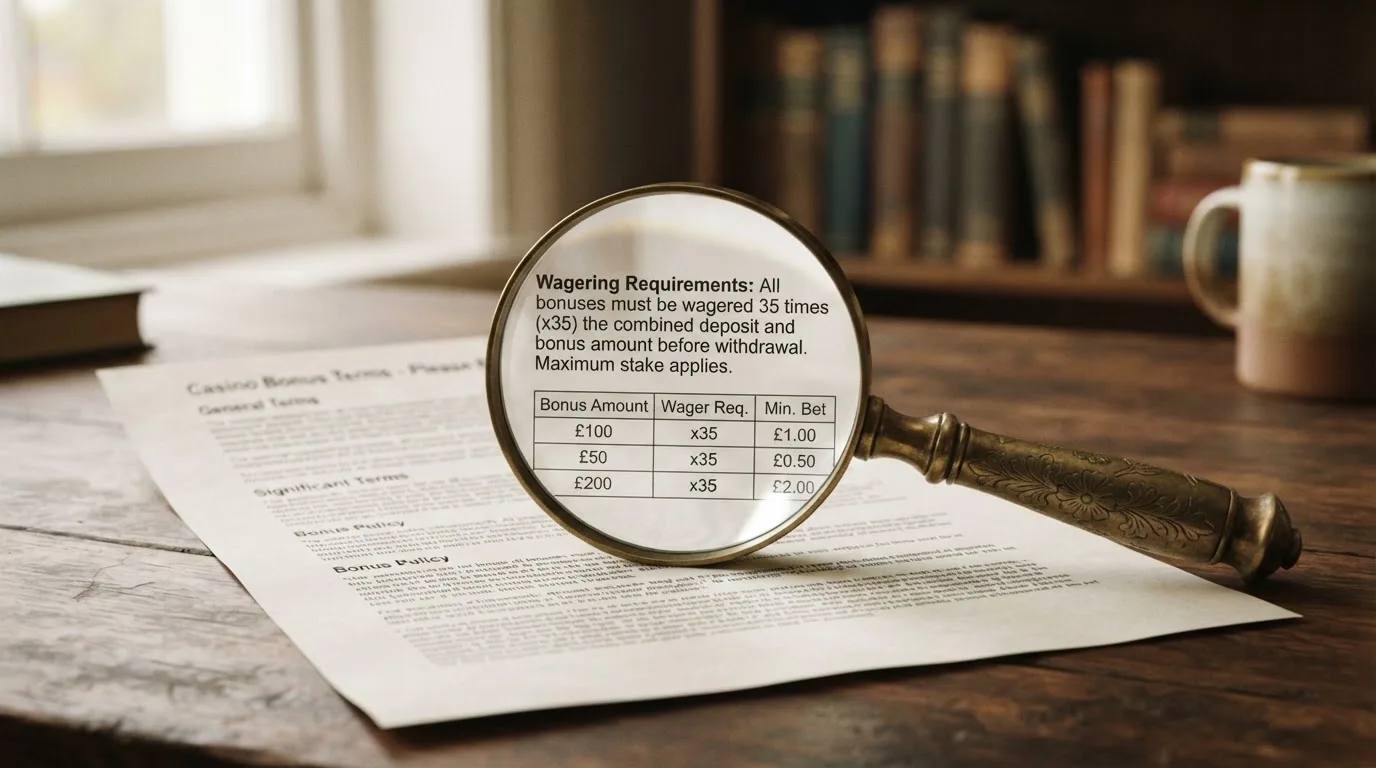
The cap is where the offer’s real price sits. A 500% match at a £10 cap looks generous and behaves modestly; a 500% match at a £500 cap is a serious commitment from the operator and a serious commitment from the player, because the bonus funds added are five times the deposit and must be turned over before they can be withdrawn. The lower the cap, the smaller the dollar value the offer adds; the higher the cap, the larger the turnover obligation the player inherits.
A typical UK 500% match is restricted to first deposits and locked to a small payment window — most commonly a single funding event at registration or shortly after. The bonus is not a top-up on the second or third deposit; it is a one-time match, and any further deposits fall back to whatever standard welcome package the operator runs. This makes the deposit decision binary: whatever the player commits at the moment the offer is live is the only amount that earns the match, and depositing less to “test the platform” forfeits the difference.
The bonus money itself is not cash. It lives in a separate balance, cannot be withdrawn as it stands, and is surrendered if the player withdraws their original deposit before the wagering requirement is cleared. That last clause is the trap the marketing rarely names: a player who wins early and tries to cash out before clearing the bonus forfeits both the bonus balance and, with some operators, any winnings derived from it. The structure rewards patience over impulse, and the player who treats the bonus as free money finds out the moment they try to leave.
What the bonus balance is and is not
The bonus balance is a counter that the operator uses to track what must be wagered. It sits beside the cash balance, plays on the same games, but cannot be withdrawn until the wagering condition is met. Some games contribute differently — slots typically contribute 100% of each bet, table games often contribute a fraction or nothing — and a player who loads a blackjack hand with bonus money expecting to clear it will find the contribution clock barely moving.
The distinction between cash and bonus matters at withdrawal. A player with £50 cash, £100 bonus, and £30 in winnings from bonus play cannot withdraw the £80 (£50 cash + £30 winnings) while the bonus is still live. They can withdraw the £50 cash and forfeit the bonus, taking £50 and losing the chance to clear the larger balance, or they can keep playing until the wagering is cleared and withdraw the whole balance minus any winnings that fall under a maximum-cashout clause. Neither option is what the headline number implied, and that is the point: the headline is about the match ratio, not about what lands in the player’s bank account at the end.
The wagering requirement, in plain numbers
The wagering requirement is the multiplier applied to the bonus, and it is the figure that decides whether the offer is worth claiming. A £100 bonus with a 10x wagering requirement means £1,000 must be staked before the bonus balance converts to withdrawable cash. A £100 bonus with a 30x requirement means £3,000. The first figure, 10x, has been the legal ceiling in Great Britain since 19 December 2025; the second figure, 30x, was ordinary in this market a year before that and is the kind of number a UK player used to see in the small print of every welcome offer.
The cap reshapes the offer more than the headline percentage does. Before 19 December 2025, a 500% match at a £100 cap with a 30x requirement meant £1,500 of turnover on a £100 deposit; after that date, with the 10x cap, the same offer means £500 of turnover. The match ratio is the same, but the play required has been cut by two-thirds. That is the single largest change the December 2025 rules made to offers of this shape, and it is the one a player comparing an old review to a new offer will feel first.
The December 2025 Wagering Cap and What It Removes
The 10x wagering cap introduced on 19 December 2025 is the most consequential rule change to UK online casino bonuses in years. It sets a hard ceiling on the multiplier operators can attach to bonus funds, banning anything above 10x, and it closes a related loophole by prohibiting mixed-product bonuses — the kind of offer where a sports bet earns the player casino free spins. Both changes were aimed at the same target: offers that asked players to turn over large multiples of small deposits, on products they had not chosen to play, in pursuit of bonuses they could not realistically clear.
The cap is generous to small offers and unfriendly to large ones. A 500% match at a £20 cap with a 10x requirement asks the player to stake £100 to clear £100 in bonus funds — manageable, and the kind of play session a small bankroll will absorb in an evening. A 500% match at a £200 cap with the same 10x requirement asks the player to stake £1,000, which is a different undertaking and a different conversation about whether the bonus is worth the deposit that triggered it.
The cap does not make 500% offers disappear. It changes what they cost, and it changes which deposits trigger them sensibly. A £10 deposit that produces a £50 bonus with £500 of turnover is a brief evening of play; a £100 deposit that produces a £500 bonus with £5,000 of turnover is a serious commitment and a long road, and the same percentage sits on both ends of the deposit range. The percentage is constant; the cost scales with the deposit that funds it.
What 10x means in practice
Ten times the bonus is a wagering requirement that an average slot clears in a single session at modest stakes. A £100 bonus at 10x means £1,000 of slot play; at 20p per spin, that is 5,000 spins, or roughly seven hours at the standard three-second spin pace. The house edge on a typical online slot of 4% would see the player expect to lose £40 across that session — meaning the £100 bonus has an expected cost of £40 in edge, against a £100 headline value, before the player has staked anything. That 60p-on-the-pound ratio is the floor the offer delivers, before any cap on winnings, any time limit, or any game contribution rule narrows it further.
What the cap removes is the offer that multiplied that edge by three or four. A 30x or 40x requirement on the same £100 bonus would mean £3,000 or £4,000 of turnover, an expected loss of £120 or £160 on the same house edge, and a session that runs into the second day of play. The offers that survived the December 2025 rule change are the ones whose turnover obligation a casual player can clear in one sitting; the offers that disappeared were the ones that asked for two or three.
Mixed-product offers, banned
The same reform package banned mixed-product bonuses: offers where a wager on one product earns a bonus on another. The clearest example was the sportsbook free bet that triggered a batch of casino spins on settlement, and the offer that paid casino bonus funds for placing an accumulator. Both shapes were common in the year before the ban and were routinely used to launder high wagering requirements across products a player would not have wagered on otherwise. The ban closed that door and confined wagering to the product the bonus was issued on, which is the same product the player chose to play.
The effect on 500% offers is indirect but real. A 500% match that previously came bundled with a sports free bet now arrives without the bundle, and the headline value of the welcome package shrinks even where the casino match itself is unchanged. A player comparing a 2024 review of a brand to its current offering will see fewer moving parts and a simpler wagering obligation, and the difference is the December 2025 reform.
Payments and the Minimum Deposit to Trigger a 500% Match
The deposit that triggers a 500% bonus is the lever the offer actually moves on, and the minimum deposit is where the offer becomes possible or impossible for a given bankroll. Most UK 500% offers set the trigger at £10, with some at £20, and a small number at £5 for the smallest offers or for promotional weekends. The figure matters because it determines the bonus ceiling that produces the largest match: a £10 minimum with a £50 cap means a £50 bonus; a £20 minimum with a £100 cap means a £100 bonus; and a £10 minimum with a £200 cap means a £200 bonus only for the player who can fund the larger deposit.
The payment method matters because the Gambling Commission banned credit cards for gambling on 14 April 2020. That ban covers every form of gambling in Great Britain, online and offline, and it extends to credit cards routed through e-wallets: a deposit funded by a credit card via PayPal or Apple Pay is still a credit card deposit and is still declined. Debit cards, bank transfers, prepaid vouchers, and certain e-wallets remain available, and a player with only a credit card to hand finds the bonus out of reach at every GB-licensed site.
Funding the offer: what works
A standard UK 500% bonus is funded by a debit card, a bank transfer via the Faster Payments Service, a prepaid voucher such as paysafecard, or an e-money institution such as AstroPay. Each method delivers the deposit to the casino’s account on a different timeline and under different rules, and a player choosing between them at the moment of claiming the offer is also choosing how quickly the bonus activates, how the deposit appears on their bank statement, and what identity checks the payment triggers.
Bank transfers through Faster Payments typically arrive within minutes, and the £1,000,000 per-transaction ceiling the scheme sets is well above any deposit a casual player will fund. The system operates 24 hours a day, which means a player claiming the offer at midnight on a Sunday faces the same arrival time as one claiming it on a Tuesday morning. Pay.UK runs the scheme and the Bank of England oversees its safety, though it does not process individual transactions. A player whose bank imposes its own lower Faster Payments limit — many do, particularly on first use — may find a large deposit declined at the bank end, even where the casino’s deposit ceiling is generous.
Debit cards carry the standard protections of the card scheme, including chargeback rights for unauthorised transactions. They are accepted at every GB-licensed casino and process deposits immediately. The £5 maximum stake per spin on slots aged 25 and over is set by the Gambling Commission and applies regardless of how the deposit was funded; it is a stake rule, not a funding rule.
Paysafecard is the prepaid voucher that wins out where a player wants hard separation between gambling spend and the rest of their finances. A paysafecard-funded deposit cannot exceed the value of the voucher, the voucher is bought with cash or debit at a retail outlet, and the deposit cannot later be reversed. The 16-digit voucher code is exchanged for casino credit, and once spent, the voucher is spent. The Gambling Commission’s paysafecard-funded 500% bonus discussion in this market centres on the spending-limit question: the voucher does not link to a bank account, which makes it invisible to a player’s own deposit tracking unless the player keeps the receipts.
Funding the offer: what does not work
A credit card is the most obvious exclusion, and any attempt to deposit via credit card at a GB-licensed site returns a hard decline at the operator’s payment processor. The Commission estimated around 800,000 UK consumers used credit cards to gamble in 2018, and its review of that population found 22% were classed as problem gamblers — a figure that drove the policy. The ban does not apply to non-remote lotteries paid for face-to-face, but it covers every online gambling product and every channel that reaches a UK customer.
E-wallets that hold credit-card-funded balances fall under the same restriction. A PayPal wallet funded by a credit card is still a credit card deposit for the purposes of the ban, and a player who has topped up their e-wallet from a credit card cannot route the funds into a casino deposit. Funding the e-wallet from a debit card or bank transfer removes the obstacle, but the e-wallet provider’s own terms may add further restrictions on gambling transactions specifically.
Crypto-funded deposits are a separate question, addressed below. For now, the working rule at a GB-licensed site is: debit card, bank transfer, certain e-wallets, certain prepaid vouchers. Anything else either declines at the cashier or pushes the player toward an offshore site that takes the deposit but does not take the Commission’s rules.
The minimum deposit, in real terms
The £10 minimum deposit that most 500% offers set is the line between a £50 bonus and no bonus. A player funding £9 receives nothing; a player funding £10 receives the full match. The deposit amount and the bonus amount are not negotiable once the offer is claimed, and a player who tops up with a view to claiming the offer should fund exactly the amount they intend to gamble with — extra cash in the account does not earn a higher match, and the casino holds the difference as cash balance rather than bonus balance.
The £10 floor is not a regulatory minimum. It is an operator choice, and a brand running a £20 minimum is asking for a higher commitment from the player in exchange for a higher ceiling on the match. A player choosing between a £10-trigger, £50-cap offer and a £20-trigger, £100-cap offer is choosing between a smaller match at lower risk and a larger match at higher risk, and the wagering requirement — capped at 10x under the December 2025 rules — multiplies whichever bonus they land on.
Crypto-Funded 500% Bonuses and Where the GB Frame Fits
Crypto deposits sit awkwardly inside a GB-licensed welcome package. The Gambling Commission does not prohibit crypto as a funding method, but every operator it licences must verify the customer’s identity, source of funds, and link between the crypto wallet and the depositor before the first withdrawal. A player funding a 500% match with Bitcoin or Ethereum will pass the standard age and identity verification at registration, but the moment they request a withdrawal the operator’s anti-money-laundering team will trace the wallet, ask for proof of ownership, and may decline the withdrawal if the source of the crypto cannot be demonstrated.
This is the gap between a crypto-funded bonus at a licensed site and a crypto-funded bonus at an offshore site. A licensed operator offers the GB protections — GAMSTOP self-exclusion, ADR route, complaints to the Commission, segregation of customer funds — but adds a crypto trace at withdrawal that an offshore operator skips. An offshore operator offers no GB protections and no crypto trace. The player who funds a 500% match with crypto at a GB-licensed site is buying both the match and the trace, and the trace is non-negotiable.
A player funding with crypto at a GB-licensed site also inherits the same wagering rules as a fiat-funded deposit: 10x cap on the bonus, no mixed-product bundles, source-of-funds verification at withdrawal. The crypto part is the funding rail, not a separate bonus track, and the operator does not loosen the bonus terms to attract crypto customers because the Commission does not allow it to. A crypto-funded 500% match looks the same on the bonus page as a debit-card-funded match, and the wagering conditions apply identically.
The licensed-versus-offshore choice
The licensed site offers protections the offshore site cannot. The offshore site offers anonymity the licensed site does not. A reader weighing the two is weighing two different trade-offs: do they want the GAMSTOP framework and the Commission’s complaints route, or do they want a wallet that does not get traced at withdrawal? The Commission has no power to block ISPs from reaching offshore sites, so the choice is the player’s, and the consequence is theirs.
The licensed site carries the December 2025 wagering cap. The offshore site does not, because the offshore site is not licensed in Great Britain and is not subject to GB rules. An offshore 500% match may carry a 40x wagering requirement, may bundle in a sportsbook free bet, and may not enforce the £5 maximum spin. The headline number is bigger, the conditions are looser, and the player has no recourse if the operator declines a withdrawal or changes the terms mid-promotion. The Commission’s enforcement against unlicensed sites — cease-and-desist notices, payment and hosting referrals, search-engine delisting — does not reach the player and does not recover losses.
Why the crypto funding detail matters for the bonus
The bonus terms do not change with the funding method, but the practical experience does. A crypto deposit arrives after a network confirmation, which can be minutes or hours depending on the coin and the network load. A fiat deposit arrives in seconds via Faster Payments. A crypto withdrawal is sent to a wallet address the player provides, and the operator will not send it until it has traced the wallet and satisfied its source-of-funds obligation. A fiat withdrawal is sent to the bank account or card the deposit came from, with no trace beyond the standard scheme protections.
A player who has been holding crypto for years and wants to deploy it at a casino faces a trace at withdrawal that may take days to clear, and a player who has just bought crypto with a view to funding a 500% match faces the same trace from a starting position of zero history. The licensed operator treats the trace as a feature; the offshore operator treats it as an unnecessary cost. Both treatments reflect a different business model, and the bonus itself is the same product underneath.
Comparing GB-Licensed Brands
The Gambling Commission’s public register of gambling businesses held 139 businesses with an active remote casino operating licence on 18 September 2026, and the same register held 1,065 active domain entries and 361 white-label domain entries on the same date. A white-label domain trades under another company’s licence — the licence holder runs the platform and the customer-facing brand is a separate commercial entity. The register can be searched online or downloaded as a CSV or Excel file, and it is the only place a brand’s licence status can be verified.
The table below lists ten brands taken from that register, with the licence holder, the GB remote casino licence number, the domain status, and the bonus support the research turned up. Several of the brands sit under the same licence holder: Ladbrokes, Coral and Gala Bingo all run under LC International Limited and share the same remote casino operating licence number 054743-R-330863-014. They are not independent operators and they should not be presented as such.
A remote casino licence number on the register has the form account-R-number-suffix, where the leading six digits repeat the licence holder’s account number and the “R” marks a remote (online) licence. The number is the test of whether a brand is GB-licensed, and the domain status — Active, Inactive or White Label — tells the reader whether the brand is trading under its own licence or under another operator’s.
| Brand | Licence holder | GB remote casino licence | Domain status | 500% bonus support |
|---|---|---|---|---|
| MrQ | Tek Fox Ltd | 060629-R-337532-004 | Active | — |
| Gala Bingo | LC International Limited | 054743-R-330863-014 | Active | — |
| Paddy Power | PPB Games Limited | 039411-R-319335-010 | Active | — |
| Casumo | Recro Limited | 061549-R-336718-002 | Active | — |
| Sky Vegas | Bonne Terre Gaming Limited | 065519-R-339675-002 | Active | — |
| BetVictor | BV Gaming Limited | 039576-R-319370-028 | Active | — |
| Coral | LC International Limited | 054743-R-330863-014 | Active | — |
| Betfred | Petfre (Gibraltar) Limited | 039544-R-319290-010 | Active | — |
| bet365 | Hillside (UK Gaming) ENC | 055149-R-331499-004 | Active | — |
| Ladbrokes | LC International Limited | 054743-R-330863-014 | Active | — |
The rightmost column carries an em dash across the board: the register confirms the brands as GB-licensed and the domains as Active, but it does not record the bonus terms each operator publishes, and the underlying fact bank carries no per-brand 500% offer to cite. A reader who sees an em dash here should read it as the register’s silence, not as a denial — the brand may run a 500% match on its promotions page, the register does not say.
The brands themselves are familiar names in the UK market, not because the regulator promoted them but because they sit on most-comparison shortlists by spend and reach. MrQ runs a smaller, slot-led operation; Bet365 is the largest UK-facing bookmaker by handle and runs casino alongside its sportsbook; Betfred is the high-street legacy brand with a substantial online presence. The licence holders are diverse, which is a structural feature of the UK market: the Commission issues licences to specific operating companies, and a brand that wants to take UK customers must either hold one of those licences itself or trade as a white-label under someone else’s.
The names that sit under one licence holder are worth pausing on. LC International Limited runs Gala Bingo, Coral and Ladbrokes from the same licence number, which means a customer opening an account at any of the three brands has their deposits, withdrawals, complaints and self-exclusion handled by the same operator. The brand on the website is a commercial layer; the licence holder behind it is the legal one. A player self-excluding via GAMSTOP is excluded across all three brands because GAMSTOP covers the operator, not the brand.
Virgin Games as a white-label example
Virgin Games trades as virgingames.com, which the Gambling Commission register lists as a white-label domain under operating licence 038905-R-319430-022. White-label status means the brand is not its own licence holder: the platform, the games, the cashier and the licence all sit with the operating company that holds 038905-R-319430-022, and Virgin Games is the customer-facing brand. The Commission does not record a 500% bonus for Virgin Games in the fact bank any more than it does for the ten brands above, and the same em dash would appear in the table if the brand were added.
The white-label status is relevant when a player is choosing where to open an account. A white-label brand cannot set its own bonus terms independently of the licence holder, because the licence holder runs the platform and the terms are platform-level. Two white-label brands under the same licence typically run similar welcome offers, and a player comparing white-label brands is comparing marketing wrappers around the same underlying product. The licence holder — the operating company — is the legal counterparty; the brand is the front of house.
The Landscape in Numbers: 18 September 2026 Snapshot
The register snapshot on 18 September 2026 is the freshest data the Commission’s published CSV carries, and it is the frame against which every brand in the table above was verified. The register lists 1,065 active domains and 361 white-label entries, indicating the scale of the licensed market, while 139 operators hold the remote casino licences.
| Brand | Licence holder | GB remote casino licence | Domain status |
|---|---|---|---|
| MrQ | Tek Fox Ltd | 060629-R-337532-004 | Active |
| Gala Bingo | LC International Limited | 054743-R-330863-014 | Active |
| Paddy Power | PPB Games Limited | 039411-R-319335-010 | Active |
| Casumo | Recro Limited | 061549-R-336718-002 | Active |
| Sky Vegas | Bonne Terre Gaming Limited | 065519-R-339675-002 | Active |
| BetVictor | BV Gaming Limited | 039576-R-319370-028 | Active |
| Coral | LC International Limited | 054743-R-330863-014 | Active |
| Betfred | Petfre (Gibraltar) Limited | 039544-R-319290-010 | Active |
| bet365 | Hillside (UK Gaming) ENC | 055149-R-331499-004 | Active |
| Ladbrokes | LC International Limited | 054743-R-330863-014 | Active |
The Commission’s register is downloadable as a CSV or Excel file, and it can be searched online. A reader checking a brand’s licence status should look up the domain name in the register and confirm the licence holder and the status. An “Active” status means the brand is currently trading under that licence; an “Inactive” status means the licence is held but the domain is not currently in use; a “White Label” status means the brand trades under someone else’s licence and is not itself the licence holder. The three statuses are the register’s own vocabulary and they are the only authoritative answer to whether a brand is GB-licensed.
The fact that the register exists and is searchable is the answer to the question a player should ask before depositing. A brand’s marketing page will say “fully licensed” or “regulated by the Gambling Commission”; the register tells the reader which licence number backs that claim, who holds it, and what status the domain sits under. The two sources should match. If they do not, the marketing page is the claim and the register is the fact, and the player should trust the register.
The Fundamentals: Who Licences Whom and Why the Licence Number Matters
A remote casino licence from the Gambling Commission is the legal permission to take bets online from customers in Great Britain. It is granted under the Gambling Act 2005 to operators that demonstrate they meet the Commission’s licensing conditions, including the Licence Conditions and Codes of Practice (LCCP) and the Remote Technical Standards. The licence is required regardless of where the operator is based: since the Gambling (Licensing and Advertising) Act 2014, any operator taking customers in Great Britain needs a Commission licence, and a Curaçao, Maltese or Gibraltar licence is not a substitute for taking UK customers.
The licence number itself, in the form account-R-number-suffix, encodes two pieces of information: the licence holder’s account number (the leading six digits) and a remote licence suffix. The account number is constant across every licence held by that operator; the suffix changes for each licence variant. A player comparing two brands who find the same leading six digits knows the brands sit under one operator, which is the same party that runs the platform, holds the customer funds, and answers the Commission’s complaints process.
What the licence obliges the operator to do
A GB-licensed operator must verify the customer’s name, address and date of birth before the first deposit or any play, a requirement in force since 7 May 2019. The verification is not a marketing checkbox; it is a Commission requirement, and an operator that lets a customer deposit without verifying is in breach. Anonymous play is not possible at a licensed site, and the verification happens early — usually at registration, with a document upload to complete the check before withdrawal.
The operator must also offer GAMSTOP, the national online self-exclusion scheme, as a mandatory condition of every online licence since 31 March 2020. A customer who self-excludes via GAMSTOP is blocked at every GB-licensed site for the period they chose — six months, one year or five years — and cannot lift the exclusion early. The exclusion covers the licence holder, which means a customer self-excluded via GAMSTOP cannot open a new account at a sister brand under the same licence.
The operator must prompt a customer to set a financial limit before the first deposit, a requirement in force from 31 October 2025. The prompt is not optional and the operator cannot bury it; it appears before the deposit is taken, and the customer can either set a limit or actively decline to. A customer who declines still deposits, but the decline is logged and the operator has discharged its duty. The prompt is the operator’s way of asking the question the customer should have asked themselves, and the answer the customer gives is the customer’s own.
What the licence obliges the operator not to do
A GB-licensed operator cannot accept credit card deposits, cannot offer wagering requirements above 10x, cannot run mixed-product bonuses, and cannot accept anonymous play. The credit card ban covers credit cards routed through e-wallets; the wagering cap covers every bonus offered to UK customers; the mixed-product ban covers free bets that trigger casino spins or casino bonuses that trigger sportsbook bets. Each rule removes a path the operator used to be able to walk down, and each rule is in force from a specific date the Commission’s published guidance names.
A GB-licensed operator also cannot run slot spins faster than 2.5 seconds, cannot offer auto-play, and cannot present losses as wins. These are game-cycle rules, not bonus rules, but they shape the experience a 500% match sits inside: a player clearing a 10x wagering requirement on slots is doing so at a steady pace, with each spin taking at least 2.5 seconds, with no auto-play to compress the session. The pace is built into the rules, not into the bonus, and a player should expect it at every licensed site.
The slot stake limits — £5 for players aged 25 and over from 9 April 2025, £2 for 18-24 from 21 May 2025 — are also game-cycle rules, not bonus rules. They limit how much each spin can stake, which limits how quickly the wagering requirement can be cleared. A player clearing £1,000 of turnover at the £5 stake does so across 200 spins; at the £2 stake, across 500 spins. The £5 figure is the current ceiling and it is set by statute, not by the operator.
What happens when a player plays at an unlicensed site
Providing gambling to people in Great Britain without a Commission licence is an offence under section 33 of the Gambling Act 2005. The Commission’s enforcement powers include cease-and-desist notices, payment and hosting referrals, and search-engine delisting. The Commission does not have ISP-blocking power and has no power to seize player funds held at an unlicensed operator.
The player does not face a penalty for playing at an unlicensed site. What the player loses is the GB-licensed site’s protections: no GAMSTOP, no Commission complaints route, no approved ADR, no segregation of customer funds under the Commission’s rules. A dispute with an unlicensed operator has to be resolved with the operator, and if the operator declines to engage, the player has no recourse. The “fully licensed” claim on an unlicensed site’s marketing page is, by definition, not a GB-licence claim; the player should look for the licence number and check the register before believing it.
Responsible Gambling: The Spending Limit, GAMSTOP and the Reality Check
A 500% match is a structural feature of the offer, but the decision to claim it is a personal one, and the responsible-gambling frame is the part of the page that names the personal decision as a decision. The Gambling Commission requires the operator to prompt a financial-limit setting before the first deposit, and the player is asked the question the operator’s prompt puts on screen: what is the maximum you are prepared to lose in a day, a week, a month? The answer is the player’s, and the operator must honour it once set.
A player who sets a £100 weekly deposit limit cannot deposit more than £100 across the week, even if a 500% match sits waiting. The limit applies across the operator’s brands under the same licence, and across the week the player chose. A limit can usually be lowered immediately and raised after a cooling-off period the operator sets — typically 24 hours for a raise, sometimes longer. The cooling-off period is the operator’s way of preventing a panicked raise in the heat of a losing session, and it is a structural feature of the limit, not a marketing add-on.
GAMSTOP, the national self-exclusion scheme
GAMSTOP is the national online self-exclusion scheme, mandatory at every GB-licensed online operator since 31 March 2020. A player who registers with GAMSTOP chooses a six-month, one-year or five-year exclusion, and is blocked from opening a new account or depositing at any GB-licensed site for the chosen period. The exclusion cannot be lifted early, and any account the player holds at the time of registration is closed and the balance returned, less any withdrawals the operator has already processed.
The exclusion covers the operator, not the brand. A player who self-excludes via GAMSTOP cannot open a new account at a sister brand under the same licence, because the licence holder sees the exclusion on the player’s record. A player who tries to register a new account at a different brand under a different licence is also blocked, because every GB-licensed operator checks GAMSTOP at registration. The exclusion is national in scope; the only escape is to wait out the period.
A player who is considering a 500% match and who has previously self-excluded via GAMSTOP cannot claim the offer until the exclusion period ends. A player who has not self-excluded but is worried about their gambling can register with GAMSTOP at any time, and the registration takes effect across every GB-licensed site. The registration is free and the process is confidential, and the National Gambling Helpline (GamCare) and GambleAware are the routes to advice on whether registration is the right step.
The reality check and the session timer
Every GB-licensed slot carries a reality check, a session-timer prompt that appears at intervals the operator sets — typically every 30, 60 or 90 minutes of continuous play. The prompt tells the player how long they have been playing and what their net win or loss is across the session. The player can dismiss the prompt and continue, but the prompt must appear, and the operator cannot disable it. The prompt is a brake, not a stop, and it works best as a regular interruption that asks the player to look at the clock.
Auto-play is banned since 31 October 2021, which means a player cannot set a slot to spin itself across hundreds of rounds unattended. Each spin is a manual action, and the pace is at most one spin every 2.5 seconds. The combination of the reality check, the auto-play ban and the spin pace means a session clearing a 10x wagering requirement takes longer than it used to, and a player planning their session around a bonus should expect to play it in real time rather than walk away from it.
What the spending-limit decision looks like at a 500% match
A player funding a £20 deposit to claim a 500% match with a £100 cap is committing to play through £120 in cash and bonus funds, with £1,000 of turnover required to clear the bonus at the 10x cap. The expected loss across that turnover, at a typical slot house edge of 4%, is £40, which is double the player’s deposit and four times what they would have lost without the bonus. The bonus pays £100 in headline value and costs £40 in expected edge, which is a real cost the player should price before claiming.
A player who sets a £100 weekly deposit limit cannot deposit more than £100, and a £20 deposit against that limit leaves £80 of headroom for the rest of the week. A player who sets a £100 weekly loss limit and then loses £40 clearing the bonus has hit 40% of their weekly limit on a single session. Both limits interact with the bonus in ways the marketing does not explain, and the prompt the operator puts on screen before the deposit is the moment the player can set them.
The National Gambling Helpline (GamCare) is the route to advice for a player who feels their gambling is no longer under control. GambleAware provides information and signposting to support services. Both are free and confidential, and both are referenced on every GB-licensed site’s responsible-gambling page.
The Calculation: How Long a 10x Wagering Requirement Takes to Clear
The 10x wagering cap means a £100 bonus requires £1,000 of turnover to clear. At a £5 maximum stake per spin on slots aged 25 and over, that is 200 spins. At the 2.5-second minimum spin pace, 200 spins takes 500 seconds, or roughly 8.3 minutes of continuous play. At a £2 stake, the same turnover is 500 spins, and at the 2.5-second pace that is 1,250 seconds, or just under 21 minutes.
The expected loss across the same £1,000 of turnover at a 4% house edge — typical of mainstream online slots — is £40. That is the cost of clearing the bonus in expectation, before any maximum-cashout clause or game-contribution rule narrows it further. The bonus pays £100 in headline value; the expected cost to clear it is £40; the player who clears it in full and makes a typical return ends the session £60 ahead of where they would have been without the bonus.
The same arithmetic, scaled up, defines the band a 500% match sits in. A £20 deposit with a £100 bonus cap means £1,000 of turnover at 10x, 200 spins at the £5 stake, and an expected loss of £40 against a £100 headline bonus. A £100 deposit with a £500 bonus cap means £5,000 of turnover at 10x, 1,000 spins at the £5 stake, and an expected loss of £200 against a £500 headline bonus. The lower deposit is a brief evening’s play; the higher deposit is a much longer commitment, and the headline percentage is the same in both cases.
The result is best stated as a band: clearing a 500% match at the 10x cap takes anywhere from a few minutes at the £5 stake on a small bonus to several hours at the £2 stake on a large bonus, and the expected cost scales with the bonus amount rather than the deposit. A player choosing between a small deposit at a low cap and a larger deposit at a high cap is choosing between a short, low-cost session and a longer, higher-cost session, and the percentage is the same in both. The deposit is the lever that moves the session length and the cost together, and the player should pick the lever position before they click claim.
The Featured Brands in Closer Detail
The ten brands below are taken from the Gambling Commission’s public register, with the licence holder, licence number and domain status recorded as the register holds them. The descriptions draw on the register’s data and on the wider Commission rules; they do not draw on the operator’s own marketing, because the marketing is not part of the research and is not a source the page can cite. Where the register is silent on a feature, the feature is not described.
MrQ
MrQ trades at Mrq.com (licence 060629-R-337532-004, Tek Fox Ltd). Tek Fox is a smaller operating company with a newer licence. MrQ is a slot-led operation; the brand’s public positioning is around straightforward casino play, and the Commission’s framework around 500% offers applies identically here — any 500% match sits inside the 10x wagering cap, the £5 stake ceiling, and the GAMSTOP screening gate.
MrQ is the kind of brand a player who prefers a smaller, single-product operator might choose. The Commission’s framework does not change with the brand, but the brand’s smaller footprint means the welcome offer is likely to be one match rather than a multi-stage package, and a player who wants the simplicity of a single 500% match at registration may find this brand easier to navigate than a multi-stage alternative.
Gala Bingo
Gala Bingo runs under LC International Limited’s licence 054743-R-330863-014. LC International also runs Coral and Ladbrokes under this same licence. Gala Bingo carries the bingo heritage in its name and runs a casino alongside, and the Commission’s framework applies across the licence rather than per brand.
A player opening an account at Gala Bingo is opening it with LC International as the counterparty. A dispute that escalates goes to LC International’s ADR route, and a complaint that goes further goes to the Commission against LC International. A self-exclusion via GAMSTOP covers the player across all three brands under the licence, and any deposit limit the player sets at one brand applies across the licence.
Paddy Power
Paddy Power operates via PPB Games Limited, licence 039411-R-319335-010. Paddy Power is a high-street legacy brand in the UK and Ireland and runs a substantial casino alongside its sportsbook. The account number 39411 is among the older entries on the register, reflecting a long-established presence.
The Commission’s mixed-product bonus ban, in force since 19 December 2025, is directly relevant here. A sportsbook-casino operator of Paddy Power’s size would previously have run offers that bundled sportsbook free bets with casino spins; the December 2025 reform banned those bundles, and the welcome offer a player sees at this brand is now a casino-only or sportsbook-only structure rather than a hybrid.
Casumo
Casumo (Casumo.com) is run by Recro Limited (licence 061549-R-336718-002). Casumo provides a casino-led offering and has historically focused on welcome packages with deposit matches plus spins; the 10x wagering cap and the absence of mixed-product bundles frame their current offers.
The brand carries an adventure-style user interface that is its commercial signature; the licence holder, Recro Limited, is the legal counterparty, and a player self-excluding via GAMSTOP is excluded at the operator level rather than at the brand.
Sky Vegas
Sky Vegas operates under Bonne Terre Gaming Limited (licence 065519-R-339675-002). Sky Vegas runs under the Sky brand, most familiar from the broadcaster; the casino is run by Bonne Terre Gaming Limited as a separate commercial entity, and the Commission’s framework applies to the licence holder.
The Sky brand name gives the casino visibility; the licence holder is Bonne Terre, and the deposit the player makes, the bonus they claim, and the complaints route they use all sit with Bonne Terre rather than with Sky.
BetVictor
BetVictor (Betvictor.com) operates via BV Gaming Limited (licence 039576-R-319370-028). BetVictor is another long-established UK-facing bookmaker with a substantial casino offering; its 39576 account number reflects its history on the register.
A casino player opening an account at BetVictor is opening it with BV Gaming as the counterparty. The Commission’s framework — 10x wagering cap, no mixed-product bundles, GAMSTOP screening — applies identically here, and the brand’s welcome offer sits within that frame.
Coral
Coral trades at coral.co.uk, listed on the register as an active domain of account 54743, LC International Limited, which holds remote casino operating licence 054743-R-330863-014. As mentioned in the Landscape section, LC International also runs Gala Bingo and Ladbrokes, and the three brands are not independent operators. A player depositing at Coral is depositing with LC International, and any GAMSTOP exclusion, deposit limit, or complaint applies across the licence.
Coral’s brand carries the high-street bookmaker legacy alongside its casino, and the December 2025 reform directly affects what was historically a sportsbook-casino hybrid offering.
Betfred
Betfred (Betfred.com) operates via Petfre (Gibraltar) Limited (licence 039544-R-319290-010). Betfred is a high-street legacy brand with an extensive online presence. The Gibraltar-based operating company is a long-standing feature of UK-facing bookmakers, supplemented by a GB licence for UK customers.
The 10x wagering cap applies to any 500% match Betfred runs, and the mixed-product ban applies to any sportsbook-casino bundle.
bet365
bet365 trades at Bet365.com, listed on the register as an active domain of account 55149, Hillside (UK Gaming) ENC, which holds remote casino operating licence 055149-R-331499-004. bet365 is the largest UK-facing bookmaker by handle and runs a substantial casino alongside its sportsbook. The Hillside (UK Gaming) entity is a dedicated UK-facing operating company, distinct from the broader Hillside group.
The December 2025 reform is particularly visible at an operator of this size, because the cross-product bundles that used to be standard at large sportsbook-casino operators are now prohibited. The 500% match a player sees at bet365, if one is offered, is a casino-only match under the 10x cap.
Ladbrokes
Ladbrokes trades at Ladbrokes.com, listed on the register as an active domain of account 54743, LC International Limited, which holds remote casino operating licence 054743-R-330863-014. As with Coral and Gala Bingo, the licence holder is LC International, and the three brands are the same operator under different commercial wrappers. A player self-excluding via GAMSTOP is excluded across all three.
The Ladbrokes brand carries the high-street bookmaker heritage; the underlying operator is LC International, and the Commission’s framework applies to LC International as the licence holder.
What a Reader Should Carry Away
A 500% casino bonus is a real offer, the GB-licensed brands that run it sit on the Commission’s public register, and the conditions the offer carries are the Commission’s rather than the operator’s. The wagering requirement is capped at 10x as of 19 December 2025; the credit card funding route is closed as of 14 April 2020; the £5 slot stake ceiling is in force as of 9 April 2025; the GAMSTOP screening gate is in force as of 31 March 2020. The combination of those rules defines what the bonus can be in a GB-licensed context, and the bonus cannot escape them.
The choice the player faces is between offers at licensed brands and offers at offshore brands. The licensed offer is smaller in headline value and tighter in conditions, and it carries the Commission’s protections — GAMSTOP, ADR, complaints, segregated funds. The offshore offer is larger in headline value and looser in conditions, and it carries none of those protections. The player picks one or the other, and the consequence of the choice is the player’s to bear.
The deposit that triggers the bonus is the lever the offer moves on. A small deposit produces a small bonus, a low turnover obligation, and a brief session; a large deposit produces a large bonus, a high turnover obligation, and a longer session. The percentage is constant; the cost scales with the deposit; and the player should pick the deposit before they click claim. The expected loss across the clearing turnover is the cost the page has been working toward, and at a 4% house edge on slots it lands at 4% of the turnover figure — which is the same percentage the bonus looks generous against, and the figure the player should price before they decide.
Frequently Asked Questions
How does a 500% casino bonus actually work?
A 500% bonus adds five times the deposit amount in bonus funds, up to a ceiling the operator sets. A £20 deposit with a £100 cap produces £100 in bonus funds and a £120 starting balance, while a £200 deposit at the same cap still produces £100 in bonus funds because the cap stops the multiplier scaling. The bonus funds cannot be withdrawn until a wagering requirement is cleared, and the wagering requirement is capped at 10x at GB-licensed operators since 19 December 2025.
What deposit amount typically unlocks a 500% match in the UK?
The minimum deposit at most GB-licensed operators running a 500% offer is £10, with some offers setting the floor at £20. The minimum is the line between triggering the bonus and missing it entirely, because the offer applies only to the first deposit and does not stack across multiple smaller deposits. A player who deposits £9 receives nothing; a player who deposits £10 receives the full match up to the ceiling.
Can I fund a 500% bonus with paysafecard?
Yes, paysafecard is accepted at most GB-licensed operators and can fund a 500% bonus, subject to the voucher’s face value. The voucher cannot be refunded once spent, the deposit cannot exceed the voucher’s value, and the payment does not link to a bank account, which means the deposit sits outside the player’s usual bank-statement visibility. The player who funds with paysafecard should keep the voucher receipts as a personal record, because the operator’s own deposit tracking may not capture the payment in the same way it captures a debit-card deposit.
What wagering requirement applies under current UK rules?
Since 19 December 2025, the wagering requirement on any casino bonus offered to UK customers is capped at 10x the bonus amount, and mixed-product bonuses that bundle sportsbook bets with casino spins are banned. A £100 bonus at the 10x cap requires £1,000 of turnover to clear; the same offer before the cap might have required £3,000 at a 30x multiplier. The cap is the largest single change to UK bonus terms in years, and the difference shows up most starkly on large match offers like 500%.
Do crypto deposits count towards a 500% welcome bonus?
Crypto deposits count towards the bonus at the GB-licensed operators that accept them, because the bonus terms apply to the deposit rather than the funding method. The wagering cap, the credit-card ban, and the verification requirements all apply identically to crypto and fiat deposits. The difference shows up at withdrawal: a GB-licensed operator will trace the crypto wallet and verify the source of funds before paying out, an offshore operator will not, and the player should price the trace against the offshore offer’s looser conditions before choosing.
How long do I have to clear a 500% bonus before it lapses?
The expiry window is set by the operator and varies by brand, but 30 days from the date the bonus is credited is the most common period at GB-licensed operators. A player who does not clear the wagering requirement within the window forfeits the bonus balance and any winnings derived from it, and the original deposit remains withdrawable. The expiry window is set in the bonus terms the player accepts at claim, and a player who intends to clear a 500% match at the 10x cap should expect to set aside real time for the play.